
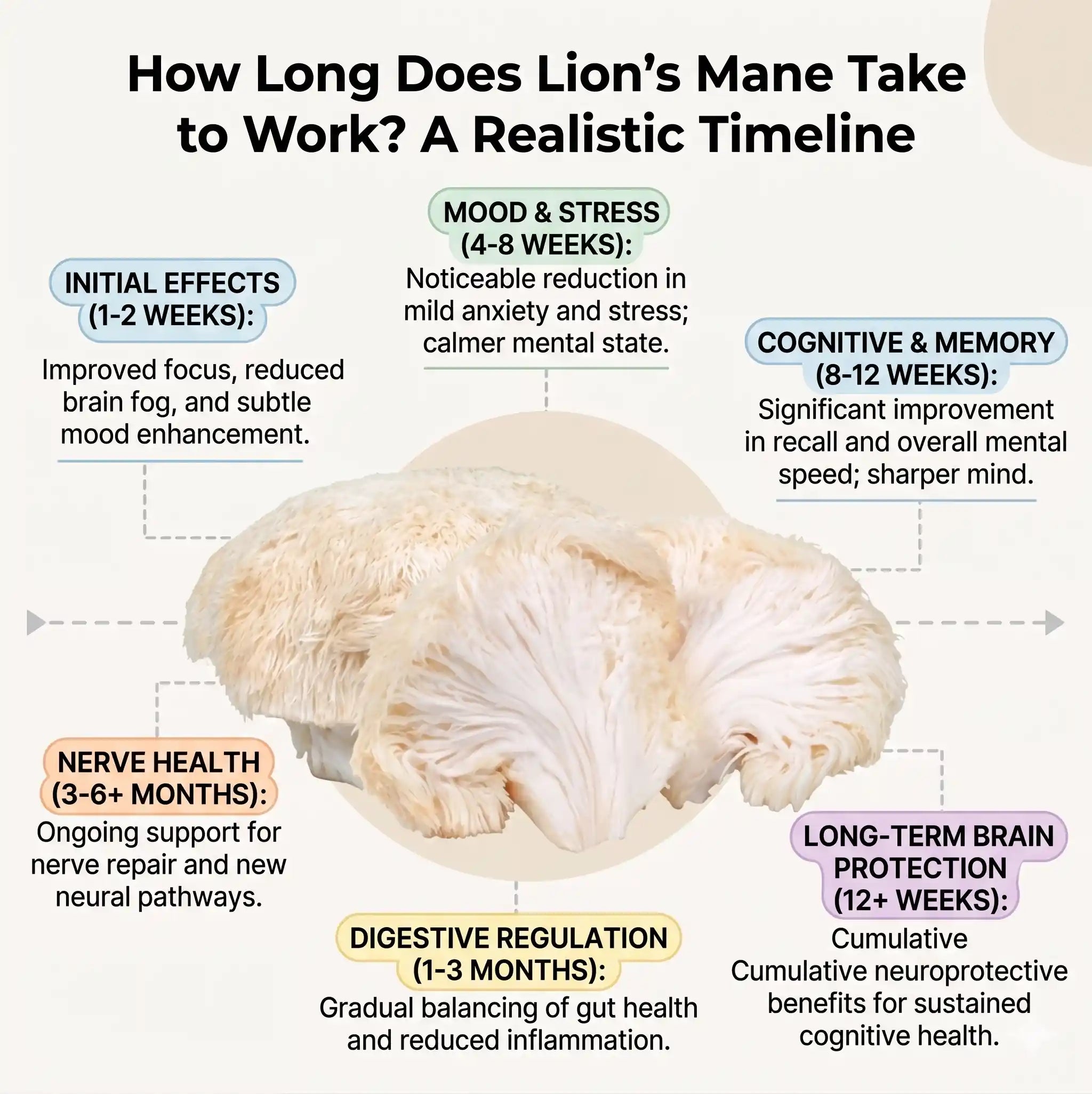
How Long Does Lion's Mane Take to Work? A Realistic Timeline
Most people report noticing subtle effects from Lion's Mane after 2 to 4 weeks of consistent daily use. Unlike caffeine, stimulants, or other compounds that produce an immediate, noticeable shift, Lion's Mane works through gradual biological mechanisms. Research has investigated its key bioactive compounds — hericenones and erinacines — for their role in supporting nerve growth factor (NGF) synthesis. NGF-related processes are inherently slow and cumulative, which means patience and consistency matter far more than any single dose.
If you've recently started taking Lion's Mane and are wondering how long it takes to work, this article lays out a realistic, week-by-week timeline based on available research and commonly reported user experiences.
Why Lion's Mane Doesn't Work Instantly
Lion's Mane (Hericium erinaceus) contains two families of compounds that have attracted significant scientific interest: hericenones (found in the fruiting body) and erinacines (found in the mycelium). Research by Lai et al. (2013) explored the neurotrophic properties of these compounds, specifically their relationship with NGF synthesis. NGF is a protein that supports the maintenance, growth, and survival of nerve cells — processes that don't happen overnight.
Think of it like exercise. You don't walk into the gym for one session and walk out stronger. Your body needs repeated, consistent stimulus over weeks before structural changes begin to show. The same principle applies here — the biological pathways that Lion's Mane compounds interact with require sustained, daily input before any cumulative effect may become noticeable.
Week-by-Week Timeline: What to Expect
Individual results vary widely, but the following timeline reflects the most commonly reported patterns and aligns with the available research.
Week 1–2: The Adjustment Period
During the first two weeks, most users report no dramatic changes — and that is completely normal. Your body is absorbing and processing the bioactive compounds, but the biological processes they support are only just beginning.
Some people notice mild digestive changes as their system adjusts. Taking your Lion's Mane with a small amount of food can help, though some evidence suggests that taking mushroom extracts on an empty stomach may improve absorption of beta-glucans. The most important thing during this window is to stay consistent.
Week 2–4: The First Subtle Shifts
This is the most commonly reported window for noticing initial changes. Some users describe improved mental clarity or a feeling of "less fog." Others report that tasks requiring sustained attention feel slightly smoother.
Keep expectations grounded. These shifts tend to be subtle — not a sudden transformation. Many people only recognise the change in hindsight, realising they've been thinking more clearly over the past week. Some people notice nothing at all until later, and that doesn't mean the supplement isn't having any effect.
Week 4–8: Where Most Users Report Noticeable Changes
Many users who track their experience report that the four-to-eight-week window is when changes become more consistently noticeable. This aligns with shorter peer-reviewed study protocols — sustained NGF-related activity over several weeks may begin to produce effects that cross the threshold of perception.
Commonly reported experiences include greater mental clarity, smoother recall, and a general sense of cognitive ease. Some users also report subtle mood-related changes, though these reports remain anecdotal. If you've been consistent for four weeks and feel nothing, don't give up just yet — many published studies used protocols that extended well beyond this point.
Week 8–16+: The Research-Backed Window
Most published studies on Lion's Mane have used protocols spanning 8 to 16 weeks. The well-known study by Mori et al. (2009) used a 16-week protocol and observed improvements in mental clarity scores among participants with mild cognitive impairment. Research by Li et al. (2018) further explored the neurohealth properties of erinacine-enriched Hericium erinaceus mycelia, adding to the evidence supporting longer-term use.
This suggests Lion's Mane is best approached as a long-term daily practice rather than a short-term experiment.
Lion's Mane Results Timeline: At a Glance
| Timeframe | What Users Commonly Report | Research Context |
|---|---|---|
| Week 1–2 | Adjusting to the supplement, minimal noticeable change | Compounds are absorbed and processed by the body |
| Week 2–4 | Some report subtle improvements in clarity or focus | Below is the duration of most peer-reviewed study protocols |
| Week 4–8 | More commonly reported cognitive and mood-related changes | Aligns with shorter peer-reviewed study durations |
| Week 8–16 | Sustained, cumulative support; more consistent reports | Mori et al. (2009) used a 16-week protocol |
| 16+ weeks | Ongoing daily maintenance; part of a long-term routine | Long-term daily use; no cycling typically needed |
Factors That Affect How Quickly Lion's Mane Works
Several key factors influence how long it takes for Lion's Mane to work for any given individual.
Product Quality
This is arguably the single biggest variable. A dual-extracted fruiting body extract contains significantly more hericenones and beta-glucans than a mycelium-on-grain product, which is often diluted with starch filler. Proper extraction methods are essential for making these compounds bioavailable. If you're taking a low-quality product, you may be getting only a fraction of the active compounds, meaning the effects will be delayed or absent entirely.
Dosage
The typical range for a quality Lion's Mane extract is 500–1,000mg per day. Underdosing is one of the most common reasons people don't notice anything. Our Lion's Mane capsules and Lion's Mane powder are both formulated with this effective dosage range in mind.
Consistency
This matters more than any other single factor. Lion's Mane works through cumulative biological processes — skipping days disrupts that accumulation. Daily, uninterrupted use is what gives the underlying mechanisms the best chance to build over time.
Empty Stomach vs With Food
Some evidence suggests that taking mushroom extracts on an empty stomach may improve the absorption of beta-glucans. However, if you experience digestive sensitivity, taking Lion's Mane with food is perfectly fine. For a deeper look at timing, see our guide on when to take mushroom extracts.
Individual Variation
Baseline health, gut microbiome, age, genetics, diet, sleep, and stress levels all influence how your body responds. Two people taking the same product at the same dose may have noticeably different timelines. This is normal.
How Do You Know Lion's Mane Is Working?
The honest answer is that Lion's Mane effects are often subtle enough that they can be easy to miss. Users who report positive experiences commonly describe things like:
- Feeling less mental fog throughout the day
- Smoother, more sustained focus during work or study
- Clearer recall in conversations
- A general sense of cognitive ease — things feel slightly "less effortful"
- Subtle shifts in mood or stress response
These changes don't arrive as a dramatic "moment." Many users describe it as a gradual realisation — looking back and noticing they've been feeling different for a while.
Our recommendation: Keep a simple daily journal for 4–8 weeks, noting your mental clarity, focus, and mood. Patterns that are invisible in the moment often become clear when you review them over time.
For those interested in the broader science behind Lion's Mane and mental clarity, our article on Lion's Mane and mental wellness provides a deeper look at the research.
What If You Don't Notice Anything?
Work through this checklist before concluding Lion's Mane isn't for you.
- Check your product quality. Is it a fruiting body extract? Is it dual-extracted? Is it third-party tested? A mycelium-on-grain product or one without proper extraction may not deliver meaningful levels of bioactive compounds.
- Check your dosage. Are you taking at least 500mg of a concentrated extract per day? Many products use low doses or are bulked with fillers.
- Check your consistency. Have you been taking it every single day for at least 4 weeks? Sporadic use won't produce the cumulative effect these compounds require.
- Check your absorption. Have you tried taking it on an empty stomach? This may increase the amount of the active compound your body actually absorbs.
If all four factors are covered and you still notice nothing after 8 weeks, Lion's Mane may not be the right fit for your individual biology — and that's okay. Not every supplement works for every person.
For some people, a multi-mushroom blend like The Daily Sync may provide a broader range of compounds that interact differently with their system.
Frequently Asked Questions
How long does Lion's Mane take to work?
Most users report noticing subtle changes after 2 to 4 weeks of consistent daily use. However, published research has typically used protocols lasting 8 to 16 weeks. Plan to take it daily for at least 4 to 8 weeks before evaluating.
Can you feel Lion's Mane immediately?
No. Unlike caffeine or stimulants, Lion's Mane does not produce an immediate effect. Its bioactive compounds have been studied in relation to nerve growth factor synthesis, a gradual, cumulative process.
How long should I take Lion's Mane for?
A minimum of 8 weeks of daily use is a reasonable starting point. Many users incorporate it into their routine on an ongoing basis. There is no established need to "cycle" Lion's Mane — long-term daily use aligns with how the research protocols have been structured.
What happens if I stop taking Lion's Mane?
Any effects that users report tend to diminish gradually after stopping. In the Mori et al. (2009) study, mental clarity scores declined after supplementation was discontinued. This is consistent with the understanding that effects are maintained through continued daily use rather than being permanent.
How do I know if Lion's Mane is working?
Keep a simple journal tracking your clarity, focus, and mood each day. After 4 to 8 weeks, review your entries for patterns. Many users only recognise the difference when they look back — or when they stop and notice the contrast.
Does the quality of Lion's Mane affect how fast it works?
Yes, significantly. A dual-extracted fruiting body product contains substantially more bioactive compounds (hericenones and beta-glucans) than a mycelium-on-grain product. Higher-quality extracts deliver more active compounds per dose, which gives the underlying biological processes more to work with. A low-quality product may significantly delay results or have no noticeable effect at all.
How much Lion's Mane should I take to see results?
The recommended range for a quality extract is 500–1,000mg per day of concentrated extract, not raw mushroom powder. Underdosing is one of the most common reasons people notice nothing. Check the label to confirm you're getting an adequate amount of extract per serving. Our Lion's Mane capsules are formulated with effective dosing in mind.
Is it better to take Lion's Mane in the morning or at night?
Most users take it in the morning or early afternoon, as it is traditionally valued for focus and clarity support. However, Lion's Mane is not a stimulant and does not typically interfere with sleep. The most important factor is choosing a time you can be consistent with daily. For detailed guidance, see our article on when to take mushroom extracts.
🔍 Looking for the Best Lion's Mane Supplement in 2026?
Not all Lion's Mane supplements are created equal. Our comprehensive Best Lion's Mane Supplements 2026 buyer's guide breaks down exactly what to look for—covering extraction methods, third-party testing, quality standards, and how to identify genuine fruiting body extracts.