We tend to think of fungi in two ways: something found in the forest, or something in a supplement capsule. But a growing global movement of designers, architects, and artists is revealing a third dimension, entirely one in which mycelium becomes the medium itself.
From acoustic panels grown in the UAE to luxury biomaterials exhibited at Design Miami, fungi are having a cultural moment that mirrors their scientific one. And for those of us who have long believed that mushrooms hold something extraordinary, it's a fascinating time to be paying attention.
The Living Material Beneath Our Feet
Before we explore the studios and galleries, it helps to understand what mycelium actually is.
When you see a mushroom, you're looking at the fruiting body, the visible tip of a vast underground network. Mycelium is the thread-like root structure that extends through soil and substrate, forming dense, interconnected webs that can span hectares. It is the circulatory system of the forest, transferring nutrients, signals, and information between organisms, a system that science is still working to fully understand.
Recent studies have confirmed mycelium's ability to communicate between fungi, trees, and other plants, in a decentralised form of thinking without a central brain. Frieze, it's this quality intelligence without hierarchy, connection without centre, that has made mycelium so philosophically compelling to the artists and designers now working with it.
NUMU: Growing Panels, Not Making Them

One of the most striking examples of fungi in contemporary design comes from the UAE.
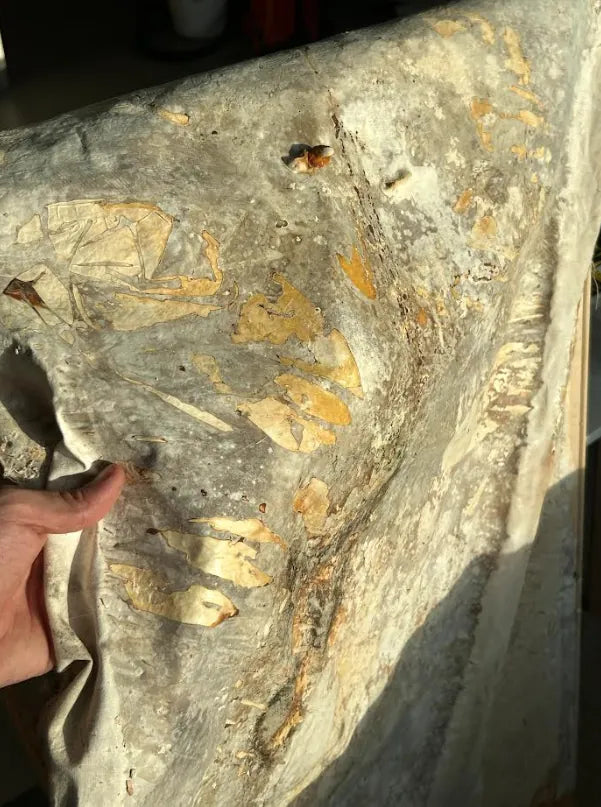
NUMU, founded by designer and biobased material expert Andy Cartier, is a design studio building a new category of interior materials from 100% mycelium.
Their flagship product, the Fungal Art Series, produces acoustic and decorative wall panels that are grown rather than manufactured. Each panel is a co-creation of nature and design, forming sculptural textures with organic uniqueness, is fully compostable, has no synthetic binders, and offers meaningful acoustic absorption.
What makes NUMU's approach particularly noteworthy is the material source. Palm fronds, locally abundant agricultural waste in the UAE, serve as the primary substrate. The mycelium colonises this waste material, binding it and transforming it into a structurally sound, aesthetically distinctive form. No two panels are identical. The living process ensures that.
This is a principle that will resonate with anyone who has spent time thinking about how nature produces quality: not through uniformity, but through process. Every fruiting body, every mycelium panel, carries the signature of its growing conditions, temperature, substrate, and timing. It is, in the truest sense, terroir.
We make these extracts. Organic, species-specific markers verified, full COAs published.
Shop All Extracts →
From Paris to London: Mycelium Enters the Gallery
The creative potential of mycelium has not gone unnoticed by the global design world.
At Design Miami's 2024 Paris edition, the Mycelium Muse exhibition brought together seven French designers working with Reishi™, a luxury mycelium biomaterial developed by MycoWorks. The material is malleable like fabric but can also be dyed, embossed, varnished, or finished like leather, grown from mycelium according to each project's specifications. Dezeen
The seven women, Sophie Dries, Anna Le Corno, Josephine Fossey, Pauline Guerrier, Marion Mailaender, Fanny Perrier, and Sarah Valente, each developed objects that deconstructed design norms while introducing new conceptions of environmental durability.
ArchDaily
One piece featured bas-relief artwork carved by hand from Reishi™ panels; another illuminated luminescent fungal patterns under ultraviolet light. These are not novelty pieces. They are serious design objects, acquired by collectors.
Meanwhile, in France, artist and designer Côme Di Meglio created Song of the Origins, a mycelium-and-oak alcove installation that contrasts a rugged exterior with a smooth carved interior, with a suspended golden gong at its centre. The structure biodegrades over time, enriching the surrounding soil and fostering new growth. Designboom. It is permanently housed in the sculpture garden at Maison Ruinart, a piece of art designed to become part of the earth.
In London, artist Abigail Brown has been exploring fungi as living collaborators in her sculpture. Working with pink oyster mushrooms grown directly onto cardboard animal sculptures, Brown has documented full growth cycles through time-lapse photography, capturing pieces from inoculation through to mushroom fruiting, wilting, and drying — a meditation on networks, connection, and the organic process of becoming.
abigail brown
Ready to try our extracts?
Organic mushroom extracts. Species-specific quality markers verified. ISO 17025 third-party tested.
Shop All Extracts
Why Artists Are Drawn to Mycelium
There's a deeper reason fungi keep appearing in contemporary art beyond their aesthetic qualities. Mycelium represents something that industrial materials cannot: a material that participates in its own creation, and eventually in its own return to the earth.
Artists have increasingly adopted mycelium as a medium for environmental art, with its use in sculptures and installations showing a significant upward trend. These projects aim to popularise mycelium and educate audiences, familiarising them with the appearance of fungal biomaterials while promoting environmentally conscious solutions. MDPI
For many in the creative world, the appeal is philosophical as much as material. Fungi have become the metaphor of choice for technologists and creatives to encapsulate new modes of thinking, collaboration, and communication
Frieze — ideas about decentralised systems, mutual support, and what it means to build something that gives back rather than takes.
This ethos is not so distant from the principles guiding our work in the functional mushroom space. The same organism that now graces the walls of design galleries in Paris is the one being studied for its compounds, cultivation methods, and its relationship with the substrates on which it grows. Quality, in both contexts, begins with understanding the living system.
The Hyphae That Connects
At Mycogenius, we spend a great deal of time thinking about mushrooms as compound sources of hericenones and erinacines in Lion's Mane, cordycepin in Cordyceps, and ganoderic acids in Reishi. We obsess over extraction ratios, third-party testing results, and the differences between log-grown and sawdust-cultivated fruiting bodies.
But the mycelium art movement is a reminder of something equally important: that fungi are not just ingredients. They are organisms with a logic and intelligence of their own, organisms that have been present on earth for hundreds of millions of years, long before we arrived to study them.
What NUMU, artists like Andy Cartier, and the Buddhist monks who first brought Lion's Mane into their practices understand is that you get the best from fungi by working with their nature rather than against it. Slow cultivation. Natural substrates. Respect for the process.
That is, in the end, what transparency in supplement quality looks like, too. Not just publishing a certificate of analysis, but understanding deeply why the numbers on that page matter and what it took to grow the mushroom that produced them.
A Final Thought
The next time you see a mycelium wall panel in a hotel lobby or a fungal sculpture in a gallery, look closely. What you're seeing is not just a design object. It's the same remarkable organism that has threaded itself through forest floors for millennia, connecting roots and transferring information in ways we're still learning to read.
Fungi, it turns out, have always been doing extraordinary things. We're only just beginning to notice.
Interested in the science behind the mushrooms we work with? Explore more articles here
Frequently Asked Questions
Q: What is mycelium and why are artists using it as a material?
A: Mycelium is the thread-like root structure of fungi that forms dense, interconnected networks through soil and substrate. Artists are drawn to it because it is a living material that actively participates in its own creation -- it grows, adapts, and eventually biodegrades, embodying principles of sustainability and decentralised design that resonate with contemporary creative philosophy.
Q: What is mycelium being used to create in art and design?
A: Mycelium is being used across a remarkable range of creative applications. These include acoustic panels grown from agricultural waste (such as palm fronds), luxury design objects crafted from biomaterials, biodegradable installations that decompose over time, and sculptural works that incorporate living fungi as a dynamic visual element.
Q: How are mycelium panels made without traditional manufacturing?
A: Rather than being manufactured, mycelium panels are grown. Agricultural waste is used as a substrate on which the mycelium feeds and expands, binding the material together into a solid form. The process relies on the organism's natural growth patterns rather than industrial fabrication, resulting in panels that are 100% biological and compostable.
Q: What is the connection between mycelium art and functional mushroom quality?
A: Both fields share a fundamental respect for natural cultivation processes. Just as artists achieve the best results by allowing mycelium to develop according to its own biological rhythms, high-quality functional mushroom extracts depend on proper growing conditions and patience rather than industrial shortcuts. Understanding this biology is central to both disciplines.
From art to extract: While artists explore mycelium as a living material, we extract its compounds for daily use. Our mushroom extracts are dual-extracted, third-party tested, and organic certified.
Explore our range →
Get the Dosage & Timing Cheat Sheet
Exact amounts and best timing for all six species, on one page. Free PDF, straight to your screen.
Something went wrong; please try again.
You'll also get our occasional research-based newsletter. Unsubscribe any time.
Done. Here's your cheat sheet.
We've also emailed you a copy so you can find it later.
Download the PDF
Mycogenius Reishi Extract
Organic dual extract. Ganoderic acids ≥1.5%. Grown 9+ months on hardwood logs. Third-party tested.
★★★★★
4.7 on Trustpilot
Shop Reishi