How to Choose the Best Lion's Mane Supplement: A Buyer's Guide
The Lion's Mane supplement market has exploded in recent years, and not all products are created equal. Walk into any health food shop or browse any online retailer, and you will find dozens of options — capsules, powders, tinctures, gummies — all claiming to deliver the benefits of this remarkable functional mushroom. But the reality behind the labels tells a very different story.
Many Lion's Mane supplements on shelves today contain mycelium grown on grain, which can consist of up to 70% starch filler. Others use single-extraction methods that overlook entire families of bioactive compounds. Some lack any form of independent testing to verify what is actually inside the capsule. For the consumer trying to find the best Lion's Mane supplement, the market can feel like a minefield.
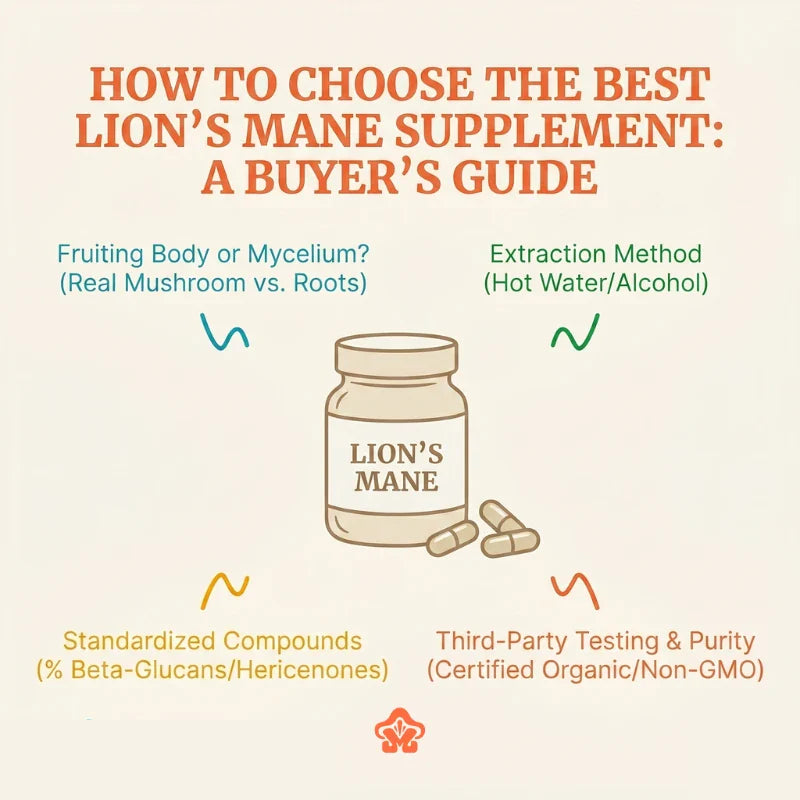
This buyer's guide covers the six quality markers that distinguish genuinely effective Lion's Mane supplements from the rest. Whether you are buying your first bottle or evaluating whether your current product meets standards, these are the criteria that matter.
Why Quality Matters More Than Brand
The supplement industry is largely self-regulated. In both the UK and Ireland, dietary supplements do not require pre-market approval as pharmaceuticals do. This means labels can be technically accurate while remaining deeply misleading. A product can legally list "Lion's Mane" as its primary ingredient even if the capsule is predominantly grain starch with trace amounts of fungal material.
Consider this: a product labelled "Lion's Mane 500 mg" could contain 500 mg of dual-extracted fruiting body — rich in hericenones and erinacines, the bioactive compounds that peer-reviewed research has focused on most intensively. Or it could contain 500 mg of grain-grown mycelium, which is mostly starch with minimal concentrations of those same compounds. Both products carry the same label claim. Both sit side by side on the same shelf. The difference in bioactive compound concentration can be tenfold or more.
This is why brand recognition alone is not a reliable guide. A well-marketed product with attractive packaging and thousands of Amazon reviews is not necessarily well formulated. Social media endorsements and influencer recommendations rarely go deeper than surface-level claims. Conversely, buying the cheapest Lion's Mane on the shelf is almost always the least effective, because quality extraction, organic sourcing, and third-party testing are expensive processes. If a product is significantly cheaper than its competitors, something has been cut.
The only reliable way to choose the best Lion's Mane supplement is to understand the quality markers that indicate whether a product delivers on its promises. Once you know what to look for — and what to avoid — evaluating any Lion's Mane product becomes straightforward. That is what this guide is designed to help you do.
The 6 Quality Markers of a Premium Lion's Mane Supplement
Not every Lion's Mane product is formulated to the same standard. These six markers are what separate a premium Lion's Mane extract from a budget product that may look similar on the shelf but delivers a fraction of the bioactive compounds.
1. Fruiting Body vs Mycelium-on-Grain
This is the single most important distinction in the entire Lion's Mane supplement market. The fruiting body is the actual mushroom — the part that grows above the substrate. It contains the highest concentrations of hericenones, the compounds that laboratory research has investigated most extensively for their neurotrophic properties (Lai et al., 2013).
Mycelium-on-grain, by contrast, is the root-like network of the fungus grown on a bed of rice, oats, or other cereal grains. Because the mycelium cannot be fully separated from its growing substrate, the final product is a mixture of fungal tissue and grain. Independent analyses have shown that mycelium-on-grain products can contain 50 to 70% starch — grain starch, not mushroom-derived bioactive compounds. This starch contributes to the milligram weight on the label but adds no meaningful bioactive value.
When searching for the best Lion's Mane supplement in the UK or Ireland, always confirm that the label specifies "fruiting body" or "100% fruiting body." If it says "mycelium," "mycelial biomass," or "myceliated grain," the product is almost certainly grain-dominant. For a complete breakdown, read our guide on the differences between fruiting bodies and mycelium.
2. Dual Extraction (Hot Water + Alcohol)
Lion's Mane contains two distinct categories of bioactive compounds, and each requires a different extraction method to liberate it from the mushroom's tough chitin cell walls.
- Hot water extraction captures beta-glucans — water-soluble polysaccharides that have been widely studied for their immunomodulatory properties (Friedman, 2021).
- Alcohol (ethanol) extraction captures hericenones, erinacines, and other terpenoids — the alcohol-soluble compounds that research has linked to nerve growth factor (NGF) synthesis in laboratory settings.
A product that uses only one extraction method — typically hot water alone — delivers only half the spectrum of Lion's Mane's bioactive profile. Some budget products skip extraction entirely and grind up raw mushroom (or mycelium-on-grain) into powder, leaving many compounds trapped behind the mushroom's indigestible chitin cell walls. Dual extraction is the standard that any serious Lion's Mane brand should meet. Without it, you are paying for a partial product — regardless of how many milligrams the label promises. For more on why extraction is essential, see our article on the bioavailability of functional mushroom extracts.
3. Standardised for Active Compounds
A quality Lion's Mane supplement should specify which active compounds have been measured and at what levels. The three key markers to look for are:
- Hericenones — alcohol-soluble compounds found in the fruiting body, researched for their role in supporting NGF synthesis.
- Erinacines — compounds that have been the focus of significant neuroscience research.
- Beta-glucans — the primary polysaccharides responsible for the natural defence-modulating properties attributed to functional mushrooms.
Be cautious of products that list only "polysaccharides" without specifying beta-glucans. Polysaccharides are a broad category that includes starch — and if the product contains mycelium-on-grain, much of the "polysaccharide" content may be inactive grain starch rather than bioactive beta-glucans. Standardisation for specific, named compounds is a hallmark of transparency and quality.
4. Third-Party Testing (ISO 17025 Accredited)
Any company can claim its product is high quality. Third-party testing provides the independent verification that separates claims from evidence. Look for testing by a laboratory accredited to ISO 17025 — the international standard for testing and calibration laboratories.
Comprehensive third-party testing should cover:
- Potency verification — confirming that the active compound levels match the label claims.
- Heavy metals — testing for lead, cadmium, arsenic, and mercury, all of which mushrooms can bioaccumulate from contaminated substrates.
- Pesticide residues — particularly important for non-organic products.
- Microbial contamination — testing for mould, yeast, E. coli, and Salmonella.
A brand that genuinely stands behind its product should make its Certificate of Analysis (COA) available, either upon request or openly published. If a company cannot or will not provide third-party test results, support that as a significant red flag. For a deeper look at what to check, read our third-party testing quality guide.
5. Organic Certification
Organic certification ensures that the mushrooms were cultivated without synthetic pesticides, herbicides, or genetically modified organisms. In Europe, EU organic certification is the standard to look for — it is recognised across the UK, Ireland, and the EU, and is subject to regular audits and inspections.
USDA Organic is the equivalent standard in the United States. Both programmes require a documented chain of custody from the farm to the finished product.
Why does organic certification matter for mushrooms specifically? Mushrooms are bioaccumulators — they absorb substances from their growing environment with remarkable efficiency. This is a desirable trait when the growing environment is clean. Still, it means that mushrooms grown on contaminated or chemically treated substrates can concentrate those contaminants in the final product. Organic certification mitigates this risk. For a full explanation, see our organic certification quality guide.
6. No Fillers or Flow Agents
The final quality marker is one of the simplest: what else is in the capsule besides the extract? Premium Lion's Mane supplements contain exactly one ingredient — Lion's Mane extract (plus the capsule shell itself, typically vegetable cellulose). That is it.
Budget supplements frequently include fillers and flow agents to reduce manufacturing costs and speed up the encapsulation process:
- Rice flour — a cheap bulking agent that adds milligram weight without bioactive value.
- Magnesium stearate — a flow agent used to prevent ingredients from sticking to manufacturing equipment.
- Silicon dioxide — an anti-caking agent.
- Maltodextrin — a starch-based filler.
Every milligram occupied by a filler is a milligram that is not delivering Lion's Mane extract. When comparing products, check the full ingredient list — not just the "active" ingredients panel. A genuinely premium product will have a very short ingredient list. If the "other ingredients" section is longer than the active ingredients section, that is worth questioning.
Quality Comparison Table: Premium vs Budget Lion's Mane
The following table summarises the key differences between a premium Lion's Mane extract and a typical budget supplement. Use this as a quick reference when evaluating any product.
| Quality Marker | Premium Extract | Budget Supplement |
|---|---|---|
| Source material | 100% fruiting body | Mycelium-on-grain |
| Extraction method | Dual (hot water + alcohol) | Single extraction or none |
| Active compounds | Standardised hericenones, erinacines, beta-glucans | "Polysaccharides" (may include inactive starch) |
| Third-party tested | Yes (ISO 17025 accredited lab) | Rarely, or self-tested only |
| Organic certified | Yes (EU Organic or USDA) | Often not certified |
| Fillers | None | Rice flour, grain, flow agents |
| Typical price | Higher per unit, lower per mg of active compound | Lower per unit, higher per mg of active compound |
| Transparency | Full COA available on request or published | Limited or no disclosure |
The price row is worth highlighting. Premium Lion's Mane supplements cost more per bottle. Still, because they deliver a significantly higher concentration of bioactive compounds per capsule, the cost per milligram of active ingredient is often lower than that of a cheap, filler-heavy alternative. You may be paying less at the checkout, but you are getting far less in return.
Common Red Flags to Avoid
Now that you know what to look for in the best Lion's Mane supplement, here are the warning signs that should make you put a product back on the shelf — or close the browser tab.
- "Proprietary blend" — This phrase means the manufacturer has combined multiple ingredients but is not disclosing the individual amounts of each. You have no way of knowing how much Lion's Mane — if any meaningful amount — is actually in the product. Reputable brands disclose exact amounts of every ingredient.
- "Full spectrum" without specifying fruiting body — "Full spectrum" sounds impressive, but it is not a regulated term. In practice, it often means the product contains a mix of mycelium and grain, marketed under a more appealing name. Always check whether the product specifies 100% fruiting body.
- Very low price — Quality dual extraction, organic sourcing, and ISO 17025 third-party testing are expensive processes. If a Lion's Mane supplement is dramatically cheaper than its competitors, something has been omitted. The most common cost-cutting measures are using mycelium-on-grain instead of fruiting bodies, skipping dual extraction, and forgoing independent testing.
- No third-party test results available — If you ask a company for their Certificate of Analysis and they cannot provide one, or they only offer in-house testing, the product's quality claims are unverified. This is not proof of a bad product, but it is a meaningful absence of proof that the product is good.
- "Polysaccharides" listed without beta-glucan specification — As discussed above, polysaccharides include starch. A product that boasts high polysaccharide content without distinguishing beta-glucans from starch may be presenting grain filler as a feature.
- "Myceliated grain" or "mycelial biomass" as the first ingredient — Check the ingredient list carefully. If myceliated grain, mycelial biomass, or any grain-based term appears as the primary ingredient, the product is predominantly grain, not mushroom.
Capsules vs Powder: Which Form Is Best?
This is one of the most common questions in any Lion's Mane supplement buying guide, and the answer is straightforward: both forms are equally effective, provided the extract quality is the same.
Capsules — such as Mycogenius Organic Lion's Mane Extract capsules — offer convenience and precise dosing. Each capsule contains an exact, pre-measured amount of extract. There is no preparation required, they are easy to travel with, and there is no taste to contend with. For most people, capsules are the simplest way to maintain a consistent daily routine.
Powder — such as Mycogenius Lion's Mane Powder — offers flexibility. You can stir it into coffee, blend it into smoothies, add it to porridge, or mix it into recipes. Powder is a good choice if you enjoy incorporating supplements into your morning ritual rather than simply swallowing a capsule.
The critical point is that neither form is inherently "better." What matters is the quality of the extract inside. A high-quality powder and a high-quality capsule made from the same dual-extracted fruiting body will deliver the same bioactive profile — the same hericenones, the same erinacines, the same beta-glucans. The delivery vehicle is a matter of personal preference, not efficacy.
One note on tinctures: liquid Lion's Mane extracts are also available, but dosing precision tends to be lower with droppers compared to capsules or measured scoops. Tinctures can also vary widely in alcohol content and extraction quality between brands. If you are considering a tincture, apply the same quality markers — particularly around extraction method and third-party testing. Choose whichever format you are more likely to use consistently, day after day. For a more detailed comparison of forms, see our guide to mushroom powder extracts vs tinctures.
What About Lion's Mane in Blend Products?
Mushroom blends — products that combine two or more functional mushroom species in a single serving — have become increasingly popular. And for good reason: different species produce different families of bioactive compounds, and combining them can offer a broader spectrum of support than any single mushroom alone.
But the same quality standards apply. A blend is only as good as its individual ingredients. Before choosing a mushroom blend that includes Lion's Mane, apply the same six quality markers covered in this guide to each ingredient in the formulation. Specifically, check that:
- Each mushroom in the blend uses a fruiting body, not mycelium-on-grain.
- The product is dual-extracted.
- Individual ingredient amounts are disclosed — not hidden behind a "proprietary blend" total.
- The blend is third-party tested and certified organic.
Two blends worth noting: The Daily Sync combines Lion's Mane with Cordyceps in a focused two-species formulation designed for daily use. The Full Harvest brings together all four — Lion's Mane, Cordyceps, Reishi, and Chaga — for those who want comprehensive functional mushroom coverage in a single product. Both disclose individual ingredient amounts and meet the same quality standards as the standalone extracts.
For a deeper comparison of the benefits of blends versus individual mushroom products, read our guide on the differences between mushroom blends and individual products.
Frequently Asked Questions
What is the best Lion's Mane supplement?
The best Lion's Mane supplement is one that meets all six quality markers: 100% fruiting body sourcing, dual extraction (hot water and alcohol), standardised levels of hericenones, erinacines, and beta-glucans, third-party testing by an ISO 17025 accredited laboratory, organic certification (EU or USDA), and no fillers or flow agents. Any product that meets all of these criteria is delivering a genuinely premium extract. Products that fall short on one or more of these markers compromise quality at some point in the supply chain.
Should I choose the fruiting body or the mycelium of Lion's Mane?
Fruiting body. The fruiting body of Lion's Mane (Hericium erinaceus) contains the highest concentrations of hericenones — the compounds most extensively researched for their neurotrophic properties. Mycelium-on-grain products contain the fungal root system grown on cereal grains, and the final product is typically 50 to 70% grain starch. While mycelium does contain some bioactive compounds (including erinacines), the grain dilution means you receive significantly less per capsule. For a thorough comparison, read our article on fruiting body vs mycelium.
How much should a good Lion's Mane supplement cost?
Expect to pay between 25 and 45 pounds or euros for a one-month supply (60 capsules) of a genuinely premium Lion's Mane extract. Organic sourcing, dual extraction, and ISO 17025 third-party testing are not cheap processes, and they are reflected in the price. Products significantly below this range are almost certainly cutting corners — typically by using mycelium-on-grain, skipping dual extraction, or omitting independent testing. Remember: the relevant metric is not cost per bottle, but cost per milligram of verified active compound.
Is Lion's Mane extract better than powder?
"Extract" and "powder" can mean different things depending on the product. A Lion's Mane extract powder has undergone an extraction process (ideally dual extraction) and then been dried into a powder — this is a concentrated, bioavailable product. Raw Lion's Mane powder with no extraction is simply the mushroom dried and ground, with many compounds still locked inside the chitin cell walls. Extract is significantly more bioavailable. When people refer to capsules vs powder, however, both can contain the same extracted material — the difference is simply the delivery format. For more, see our guide to bioavailability and why extraction is essential.
What dosage of Lion's Mane should I look for?
For a dual-extracted fruiting body product, 500-1,000 mg per day is the most widely recommended dose range. This typically equates to one or two capsules. A well-known peer-reviewed trial by Mori et al. (2009) used 3,000 mg per day of non-extracted Lion's Mane powder — which, adjusted for extraction concentration, is broadly comparable to 1,000 to 1,500 mg of a quality dual extract (Phytotherapy Research, PMID: 18844328). Quality matters more than quantity: 500 mg of a premium dual-extracted fruiting body delivers more bioactive compounds than 2,000 mg of an unextracted mycelium-on-grain product.
How can I verify the quality of Lion's Mane supplements?
Ask the manufacturer for their Certificate of Analysis (COA) from an ISO 17025-accredited third-party laboratory. A legitimate COA will show: verified levels of active compounds (hericenones, beta-glucans), heavy metal test results (lead, cadmium, arsenic, mercury), pesticide residue testing, and microbial contamination screening. Additionally, check the ingredient list for fillers and flow agents, confirm the product specifies "fruiting body" (not mycelium-on-grain), and look for valid organic certification from a recognised body such as the EU Organic programme or USDA Organic.
Are Lion's Mane blends as effective as standalone products?
Yes — provided the blend meets the same quality standards. A well-formulated blend that uses dual-extracted, organic fruiting bodies for each ingredient and discloses individual amounts can be just as effective as standalone products, with the added benefit of a broader spectrum of bioactive compounds from multiple species. The key is transparency: avoid blends labelled "proprietary blend" that hide the amounts of individual ingredients. Products like The Daily Sync (Lion's Mane + Cordyceps) and The Full Harvest (Lion's Mane, Cordyceps, Reishi, Chaga) are examples of blends that maintain full ingredient disclosure and the same quality standards as their standalone counterparts. For more on this topic, see our comparison of blends vs individual mushroom products.
Making an Informed Decision
Choosing the best Lion's Mane supplement does not require a degree in mycology. It requires asking the right questions — and knowing which answers to look for. The six quality markers in this guide give you a clear, repeatable framework for evaluating any Lion's Mane product on the market, whether you are shopping in the UK, Ireland, or anywhere else.
To summarise: look for 100% fruiting body sourcing, dual extraction (hot water and alcohol), standardised levels of hericenones, erinacines, and beta-glucans, third-party testing by an ISO 17025 accredited laboratory, organic certification, and a clean ingredient list with no fillers or flow agents. Any product that meets all six criteria is a genuinely premium extract. Any product that falls short on two or more is cutting corners.
Mycogenius products — including our Organic Lion's Mane Extract capsules, Lion's Mane Powder, The Daily Sync, and The Full Harvest — are formulated to meet every one of these standards. We publish our Certificates of Analysis, use only dual-extracted organic fruiting bodies, and include nothing in our capsules except mushroom extract and the vegetable cellulose shell. But rather than taking our word for it, use this guide to verify those claims for yourself. That is exactly how it should work.
🔍 Looking for the Best Lion's Mane Supplement in 2026?
Not all Lion's Mane supplements are created equal. Our comprehensive Best Lion's Mane Supplements 2026 buyer's guide breaks down exactly what to look for—covering extraction methods, third-party testing, quality standards, and how to identify genuine fruiting body extracts.