
Natural Nootropics Explained: What They Are & How Mushrooms Fit In
The word nootropic gets used a lot. It appears on coffee packaging, supplement labels, and wellness influencer captions, often without much explanation of what it actually means.
This article is that explanation.
We'll cover what the term' nootropic' means, how natural and synthetic versions differ, what the current research says, and where functional mushrooms sit within this broader category. No hype. No health claims. Just a clear, honest look at a genuinely interesting area of nutritional science.
What Is a Nootropic?
The term was coined in 1972 by Romanian psychologist and chemist Dr Corneliu Giurgea. He used it to describe compounds that may support mental performance, are non-toxic at normal doses, and protect the brain rather than simply stimulating it.
Giurgea proposed a set of criteria: a nootropic should influence cognitive processes, have a very low toxicity profile, and should not produce the side effects typical of stimulants. By his original definition, the category is quite narrow.
Today, the term is used far more loosely. It broadly refers to any substance, natural or synthetic, that people take with the aim of supporting mental clarity, alertness, or cognitive performance. That wider definition includes everything from caffeine to prescription racetams to Lion's Mane extract.
Understanding that distinction matters because not everything marketed as a nootropic is the same thing.
Natural vs Synthetic Nootropics: What's the Difference?
The core distinction is origin and mechanism.
Synthetic nootropics are laboratory-produced compounds. Some, like racetams (piracetam, aniracetam), were developed specifically for pharmacological research. Others, like modafinil, are prescription medications used off-label by people seeking focus and clarity support. These compounds tend to have direct, well-characterised mechanisms of action, but also more clearly defined risk profiles, legal restrictions, and, in many cases, limited long-term safety data.
Natural nootropics come from food and plant sources. They include herbs with long histories of traditional use, amino acids found in food, and fungi consumed across cultures for centuries. Their mechanisms are generally more complex; they work through multiple pathways simultaneously rather than a single receptor, and their effects tend to be subtler and more gradual.
The research landscape differs, too. Synthetic compounds often have more published trials behind them, partly because pharmaceutical investment funds conduct research. Natural compounds have attracted growing scientific investigation, but the evidence base is less uniform — some are well-studied, others are not.
Neither category is inherently superior. They are simply different tools, with different profiles, suited to different contexts and preferences.
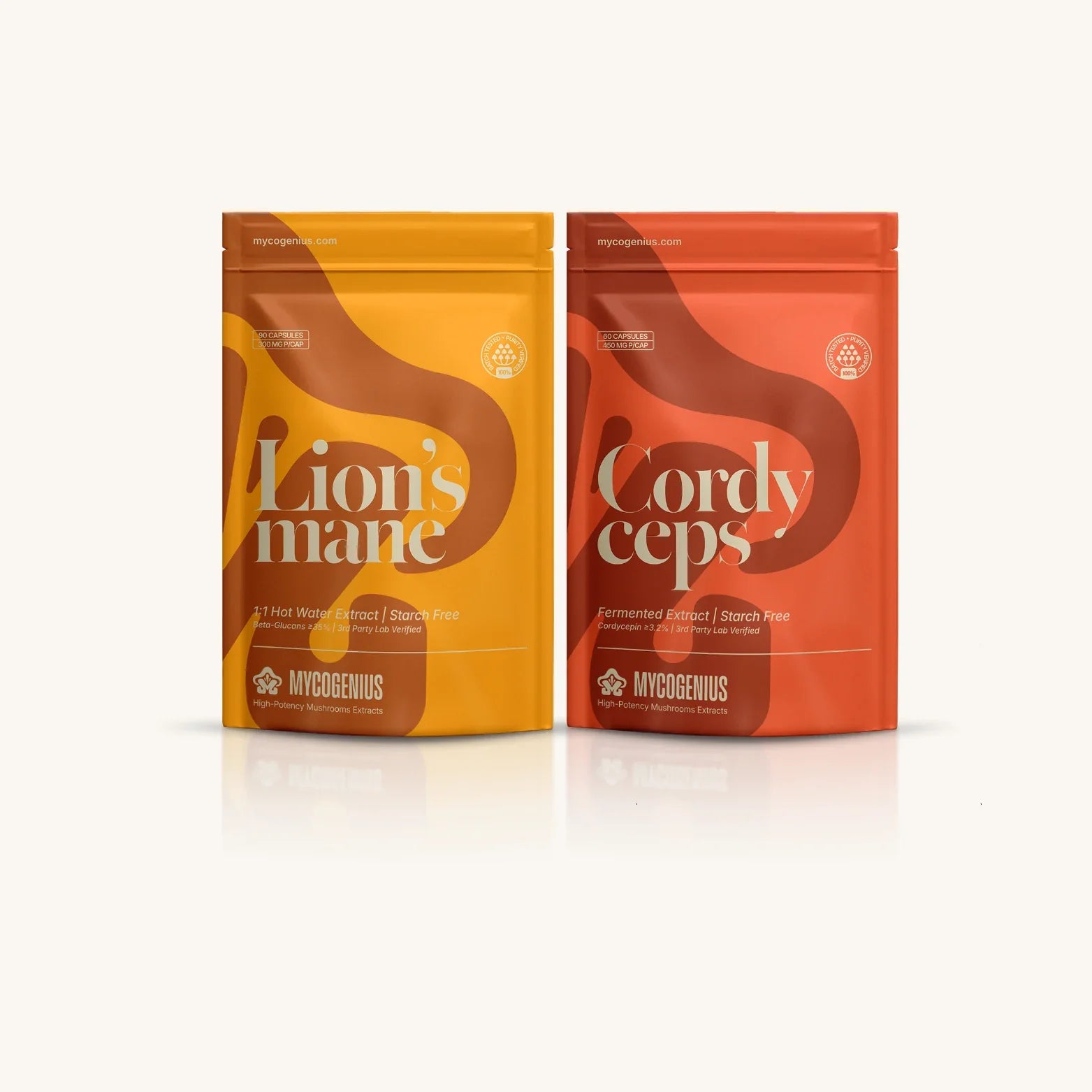
We make these extracts. Organic, species-specific markers verified, full COAs published.
Shop All Extracts →Common Natural Nootropics Found in Food and Supplements
Several natural nootropics have accumulated meaningful research attention. Here are the ones most frequently discussed in the scientific literature.
Caffeine + L-Theanine
Perhaps the most studied natural nootropic combination. Caffeine is found in coffee, tea, and cacao. L-theanine is an amino acid found predominantly in green tea. Research suggests that the two compounds interact; L-theanine is associated with a more sustained, even alertness profile compared to caffeine consumed alone. This pairing is widely referenced in the nootropic community as a foundational starting point.
Bacopa Monnieri
An herb used in Ayurvedic tradition for centuries. Bacopa contains bacosides, compounds that have been studied for their effects on memory and learning. Research timelines are important here, many Bacopa studies track outcomes over 8–12 weeks, suggesting effects accumulate gradually rather than appearing immediately.
Rhodiola Rosea
An functional herb with roots in Scandinavian and Russian traditional medicine. Rhodiola has been studied in the context of mental fatigue, particularly under conditions of stress or sleep restriction. It contains rosavin and salidroside as its primary active compounds.
Ginkgo Biloba
One of the oldest tree species on earth, and one of the most extensively studied botanicals in the nootropic space. Ginkgo has a long research history, particularly in European peer-reviewed settings.
Lion's Mane (Hericium erinaceus)
The functional mushroom that most clearly occupies the nootropic conversation, and the one we'll look at in more detail below.
Where Functional Mushrooms Fit In
Functional mushrooms are not a new category. They have been used across Asian traditional medicine systems for centuries, in China, Japan, Korea, and Tibet, with documented uses spanning both everyday wellness and more structured traditional practices.
What makes them relevant to the nootropic conversation is their compound profiles. Different species contain distinct bioactive compounds, and research examining them has expanded considerably over the past two decades.
It's worth being precise here: functional mushrooms are not a single thing. Each species has a distinct compound profile, research history, and traditional context. Grouping them under one umbrella is useful for understanding the category, but shouldn't obscure their differences.
Lion's Mane and the Nootropic Conversation
Of all the functional mushroom species, Lion's Mane (Hericium erinaceus) sits most clearly within the nootropic discussion.
The reason is compound-specific. Lion's Mane fruiting bodies contain hericenones, while liquid-grown mycelium contains erinacines. Both classes of compounds have been investigated in the context of Nerve Growth Factor (NGF), a protein involved in neuronal maintenance and growth. This mechanism underpins most Lion's Mane research and explains why the mushroom has attracted serious scientific interest beyond the wellness world.
It's important to understand what the research actually shows and what it doesn't. Studies have examined these compounds in laboratory settings, in animal models, and in a smaller number of human trials. The findings are interesting. They are not conclusive. And they do not translate directly into label claims.
What can be said accurately: Lion's Mane is a functional food with a distinctive compound profile that researchers are actively investigating. Many people incorporate it into their daily routines and report their own experiences with it. The research is ongoing.
Quality matters enormously in this context. Because hericenones and erinacines are specific to Lion's Mane and found in meaningful concentrations only in genuine fruiting body extracts, the quality of the raw material determines whether any of the research conclusions are even relevant to the product in your hands. Independent analysis of 30 commercially available Lion's Mane extracts found a 16-fold variation in beta-glucan content between the lowest and highest-performing samples. The species-specific compounds that define Lion's Mane's profile were not detected in the majority of samples tested.
This is not a peripheral concern. It is the central one.
Ready to try our extracts?
Organic mushroom extracts. Species-specific quality markers verified. ISO 17025 third-party tested.
Shop All ExtractsCordyceps and Active Lifestyle Contexts
Cordyceps militaris occupies a different part of the nootropic and functional supplement conversation. Traditionally used by Tibetan communities and documented in Chinese medicine, Cordyceps has been studied primarily for its effects on physical performance and cellular energy metabolism.
Its key compound is cordycepin, a naturally occurring nucleoside analogue. Adenosine, involved in cellular energy transfer, is also present at meaningful concentrations. Research has examined Cordyceps in relation to oxygen utilisation and ATP production, which is why it tends to appear in active-lifestyle and sports-nutrition contexts rather than in pure cognitive discussions.
Whether Cordyceps qualifies as a nootropic depends on your definition. By the strict Giurgea criteria, arguably not. By the broader contemporary usage, it sits comfortably within the functional and performance-support category that many nootropic users explore.
For a detailed look at what separates a quality Cordyceps product from the rest, see our guide to choosing the best Cordyceps supplement.
Reishi and the Functional Frame
Ganoderma lucidum, known as Reishi, occupies yet another distinct position. Historically known as the "mushroom of immortality" in Chinese culture, Reishi has been used in traditional practice for over 2,000 years.
Its primary bioactive compounds are ganoderic acids, a class of triterpenes, and polysaccharides, including beta-glucans. Research has examined Reishi in the context of stress response, natural balance support, and sleep quality, placing it more clearly in the functional category than the stimulant-adjacent nootropic one.
Many users incorporate Reishi into evening routines rather than morning stacks, a practical reflection of its research profile and traditional use context.
A Note on Quality and What It Means for This Category
The nootropic supplement market, both natural and synthetic, has a well-documented quality problem. Because compounds like hericenones, cordycepin, and ganoderic acids are not regulated as pharmaceuticals, there is no mandatory requirement for brands to verify that their products actually contain what the label claims.
For natural nootropics sourced from functional mushrooms, this creates a specific issue: the difference between a genuine fruiting body extract and mycelium grown on grain substrate can be enormous in terms of compound concentration, yet both can carry identical label claims.
The only meaningful signal of quality in this space is third-party testing conducted by an accredited laboratory, on the finished product, examining species-specific bioactive markers. Not heavy metals alone. Not polysaccharide percentage alone. Actual compound verification.
At Mycogenius, every batch is third-party tested by an ISO 17025-accredited laboratory. Results are accessible via QR code on each product. This is not the industry standard. We believe it should be.
What to Take Away
Natural nootropics are a legitimate and growing area of nutritional science. They are not miracle compounds, and honest brands won't describe them that way. They are food-derived substances with distinctive compound profiles, long histories of traditional use, and an expanding body of research worth following closely.
Functional mushrooms occupy a specific and interesting position within this category, grounded in both scientific investigation and centuries of documented traditional use. But as with all supplements, the quality of what you're actually consuming determines whether any of that matters in practice.
Start with quality. Verify it independently. And be appropriately sceptical of anyone who promises more than the evidence currently supports.
Frequently Asked Questions
What does nootropic mean?
The term was coined in 1972 to describe compounds that may support cognitive processes, are non-toxic at normal doses, and do not produce the side effects of classical stimulants. Today it is used more broadly to refer to any substance taken with the intention of supporting mental clarity or alertness, whether natural or synthetic.
What is the difference between natural and synthetic nootropics?
Natural nootropics are derived from food and plant sources, including herbs, fungi, and amino acids found in food. Synthetic nootropics are laboratory-produced compounds, some of which are prescription medications used off-label. They differ in mechanism, research depth, legal status, and risk profile.
Are functional mushrooms considered nootropics?
Some functional mushroom species, particularly Lion's Mane (Hericium erinaceus), are frequently discussed in the nootropic context due to their unique compound profiles and the research examining those compounds. Others, like Cordyceps and Reishi, sit more clearly within the functional and wellness-support categories. The classification depends on the definition of "nootropic" used.
What compounds in Lion's Mane are relevant to nootropic research?
Lion's Mane fruiting bodies contain hericenones, while liquid-grown mycelium contains erinacines. Both have been investigated in the context of Nerve Growth Factor (NGF). These are the species-specific compounds that distinguish Lion's Mane from other functional mushrooms and from generic polysaccharide supplements.
How do I know if a natural nootropic supplement is high quality?
Look for third-party testing by an ISO 17025-accredited laboratory, conducted on the finished product rather than raw materials, and that examines species-specific bioactive compounds, not just heavy metals or generic polysaccharide content. Accessible Certificates of Analysis (COAs) per batch are the clearest transparency signal available.
Can I take functional mushrooms alongside other natural nootropics?
Many people combine functional mushrooms with other natural nootropics such as caffeine, L-theanine, or functional mushrooms. As with any supplement, individual responses vary. If you are taking medication or managing a health condition, consulting a healthcare professional before adding any supplement is advisable.
Are natural nootropics regulated in the EU?
In the EU, natural nootropic supplements are regulated as food supplements under Directive 2002/46/EC. Health claims are governed by the European Food Safety Authority (EFSA) and are strictly controlled. Brands operating compliantly cannot make direct claims about cognitive or health outcomes. Consumers should be cautious of brands making strong performance promises, as these often indicate regulatory non-compliance.
How long does it take for functional mushrooms to have an effect?
This varies significantly between individuals and depends on multiple factors, including product quality, dose, consistency of use, and individual physiology. Most research tracking Lion's Mane outcomes follows participants over 8–12 weeks. Users commonly report that effects accumulate gradually rather than appearing immediately. Individual variation is real and should be acknowledged honestly.
Get the Dosage & Timing Cheat Sheet
Exact amounts and best timing for all six species, on one page. Free PDF, straight to your screen.
Something went wrong; please try again.
You'll also get our occasional research-based newsletter. Unsubscribe any time.
Done. Here's your cheat sheet.
We've also emailed you a copy so you can find it later.
Download the PDFMycogenius Reishi Extract
Organic dual extract. Ganoderic acids ≥1.5%. Grown 9+ months on hardwood logs. Third-party tested.
★★★★★ 4.7 on Trustpilot
Shop Reishi