
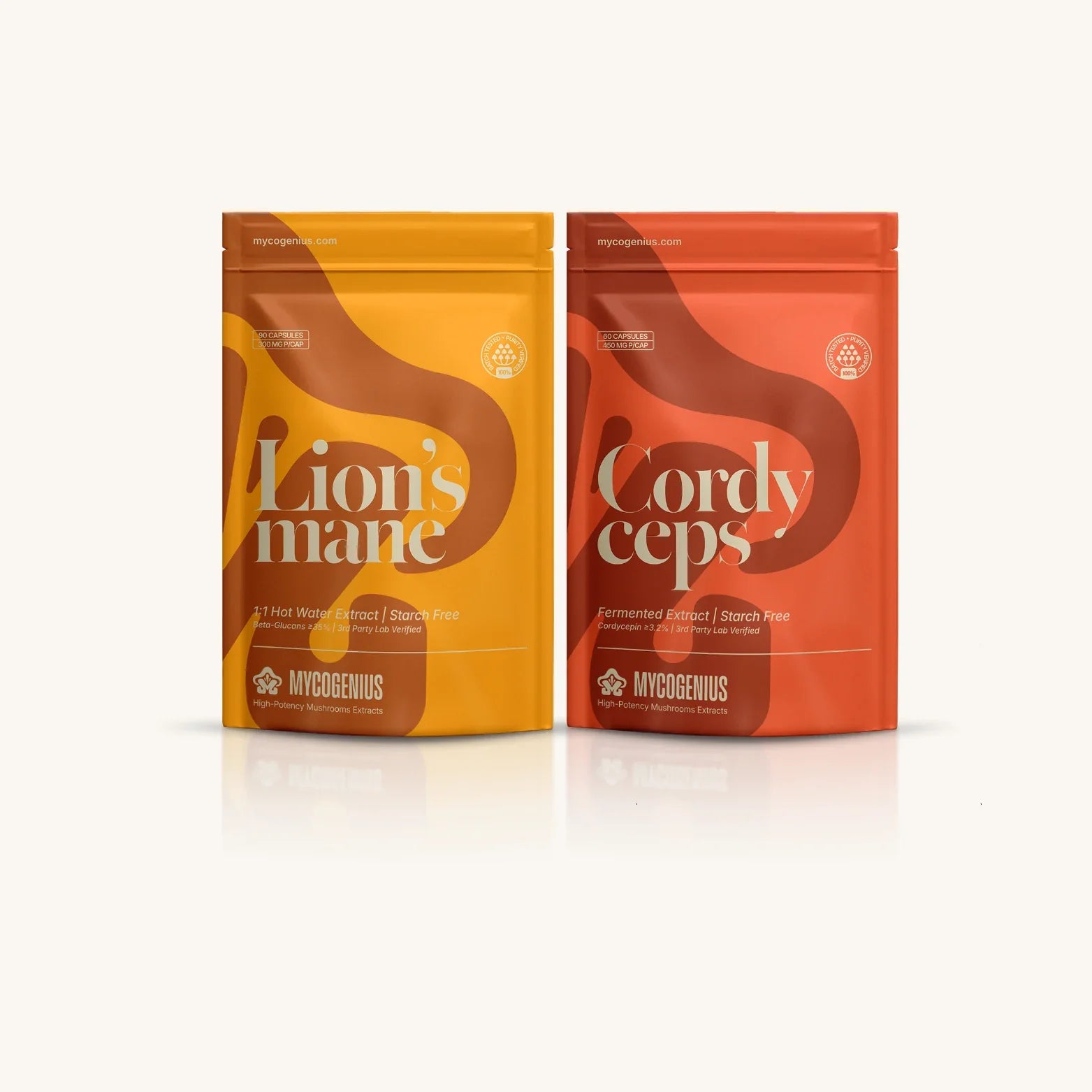
Can You Take Lion's Mane and Cordyceps Together? What the Research Says
If you've been exploring functional mushrooms, this question comes up fast: can you mix Lion's Mane and Cordyceps? The short answer is yes. Lion's Mane (Hericium erinaceus) and Cordyceps (Cordyceps militaris) can be taken together safely, and many people do exactly that. These two species contain different classes of bioactive compounds, target different physiological pathways, and have no known negative interactions with each other. Combining them into a single daily routine — sometimes called a mushroom stack — is one of the most popular approaches in the functional mushroom space.
Below, we'll walk through what each mushroom brings to the table, why people combine them, how to take them together, and what to keep in mind before you start.
What Does Each Mushroom Contain? A Brief Profile
Before exploring why people take Lion's Mane and Cordyceps together, it helps to understand what makes each species distinct. These are not interchangeable mushrooms — they produce entirely different families of compounds, which is precisely why combining them is so appealing.
Lion's Mane (Hericium erinaceus)
Lion's Mane is a white, shaggy mushroom that has been traditionally valued in East Asian herbalism for centuries. Modern research has focused on two families of compounds unique to this species:
- Hericenones — a class of meroterpenoids found in the fruiting body
- Erinacines — cyathane diterpenoids primarily found in the mycelium
Peer-reviewed research has investigated both compound families for their ability to stimulate nerve growth factor (NGF) synthesis in vitro. A study in the International Journal of Functional Mushrooms demonstrated that hericenones and erinacines promoted NGF synthesis in nerve cell cultures (Lai et al., 2013). A 2018 review further examined the neurohealth properties of erinacine-enriched mycelia (Li et al., 2018).
Lion's Mane also contains beta-glucan polysaccharides, common across many functional mushroom species. For a deeper look, see our guide on Lion's Mane and mental wellness.
Cordyceps (Cordyceps militaris)
Cordyceps has a long history in traditional Chinese and Tibetan herbalism, where it was traditionally valued as a tonic for vitality. The cultivated species used in modern supplements is Cordyceps militaris, which produces several well-studied compounds:
- Cordycepin (3'-deoxyadenosine) — a nucleoside analogue structurally similar to adenosine
- Adenosine — a compound involved in cellular energy transfer (ATP metabolism)
- Beta-glucan polysaccharides — shared with other functional mushroom species
A 2020 study in Mycobiology explored the relationship between C. militaris supplementation and cellular energy production, finding measurable effects on biomarkers related to the ATP generation pathway in animal models (Jung et al., 2020). Earlier human studies reported improvements in VO2max after 3 weeks of Cordyceps supplementation (Hirsch et al., 2017).
For more on Cordyceps, see our article on Cordyceps mushrooms for natural energy and stamina.
Lion's Mane vs Cordyceps: Side-by-Side Comparison
This table summarises the key differences between these two species — and illustrates why they complement each other so well in a Lion's Mane Cordyceps stack.
| Lion's Mane | Cordyceps | |
|---|---|---|
| Species | Hericium erinaceus | Cordyceps militaris |
| Key Compounds | Hericenones, erinacines, beta-glucans | Cordycepin, adenosine, beta-glucans |
| Traditional Use | Focus and clarity support, nerve health | Vitality, stamina, and respiratory health |
| Primary Research Focus | NGF synthesis, neuroprotection | ATP metabolism, cellular energy |
| Body Part Used (Quality Products) | Fruiting body | Fruiting body |
| Mycogenius Forms Available | Extract Capsules, Powder | Extract Capsules, Powder |
We make this extract. Organic Lion's Mane, third-party tested, full COA published.
Shop Lion's Mane →Why Do People Take Lion's Mane and Cordyceps Together?
The answer is straightforward: they contain complementary compound profiles. Lion's Mane is associated with nerve-related compounds (hericenones and erinacines), while Cordyceps is associated with energy-related compounds (cordycepin and adenosine). There is no overlap or competition between these pathways.
- Complementary compounds — Hericenones and erinacines work along neurotrophin pathways, while cordycepin and adenosine are involved in cellular energy transfer. Taking both gives you access to both compound families in a single routine.
- Morning-friendly pairing — Many Mycogenius clients take both mushrooms in the morning. Cordyceps is traditionally taken earlier in the day, and Lion's Mane pairs well with that same window. For more on timing, read our guide: When Should You Take Mushroom Extracts?
- Simplicity — Rather than evaluating dozens of mushroom species, many people start with just two — one for neurotrophin-related compounds, one for energy-related compounds — and build from there.
This complementary profile is the core reason why the benefits of cordyceps and Lion's Mane are so frequently discussed together in the functional mushroom community.
How to Take Lion's Mane and Cordyceps Together
If you're new to combining these mushrooms, here's a practical framework to get started.
Dosage Considerations
Most standalone mushroom extracts are taken at 500-1,000 mg per serving. When combining two species, many people start at the lower end of each and adjust based on how they feel over the first two weeks. There is no established peer-reviewed consensus on an "optimal" combined dose, so starting conservatively is a sensible approach.
Timing
Both Lion's Mane and Cordyceps are commonly taken in the morning, ideally 30 to 60 minutes before a meal, to improve absorption of beta-glucan polysaccharides. If you find Cordyceps too stimulating later in the day, keeping both in your morning routine avoids any issues with evening restfulness. Our timing guide goes into more depth on this topic.
Capsules vs. Powder
Both forms work. Capsules offer convenience and consistent dosing. Powder offers flexibility — you can add it to coffee, smoothies, or other drinks. Mycogenius offers both Lion's Mane and Cordyceps in capsule and powder form, so the choice comes down to personal preference and lifestyle.
What to Look for in Quality
Whether you buy individual species or a combined stack, look for these quality markers: organic certification, fruiting body sourcing (not mycelium-on-grain, which dilutes active compounds with starch), dual extraction (hot water + alcohol to capture both beta-glucans and terpenoids), third-party testing for potency and contaminants, and no fillers — no grain, no starch, no synthetic additives.
The Simplest Way to Stack Lion's Mane and Cordyceps: The Daily Sync
If the idea of buying two separate products, measuring two doses, and timing them both sounds like more friction than you want, there's a simpler option.
The Mycogenius Daily Sync is a pre-made mushroom stack that combines dual-extracted Lion's Mane and Cordyceps CS-4 in a 1:1 ratio. It was designed for exactly this use case: people who want both compound profiles in a single, daily-use product.
Here's what's in it:
- Lion's Mane fruiting body extract — rich in hericenones
- Cordyceps CS-4 fruiting body extract — rich in cordycepin and adenosine
- Organic, dual-extracted, third-party tested
- No fillers, no grain, no synthetic additives
- Available in both capsule and powder formats
Rather than managing two separate bottles, The Daily Sync gives you a calibrated Lion's Mane Cordyceps stack in one product — with the same quality standards as our individual extracts, just combined into a single formula. One scoop (powder) or two capsules, 30 minutes before breakfast, and you're set for the day.
Potential Considerations Before Combining Mushroom Supplements
While Lion's Mane and Cordyceps are generally well-tolerated and have a long history of traditional use, there are a few things worth keeping in mind.
Start Slowly
If you've never taken either mushroom before, consider starting with one species at a time for a week or two before combining them. This makes it easier to identify how your body responds to each one individually.
Medication Interactions
Both Lion's Mane and Cordyceps have been studied for various biological activities. If you are currently taking any medications — particularly blood-thinning medications, immunosuppressants, or diabetes medications — consult your healthcare provider before adding any mushroom supplement to your routine.
Pregnancy and Breastfeeding
There is insufficient peer-reviewed data on the safety of either mushroom during pregnancy or breastfeeding. If you are pregnant, nursing, or planning to become pregnant, speak with your healthcare provider first.
Quality Matters
Not all mushroom supplements are equal. Whichever product you choose, prioritise the quality markers outlined above: organic, fruiting body, dual-extracted, third-party tested, and free of fillers.
Get both in one
The Daily Sync combines Lion's Mane and Cordyceps. One formula, both extracts.
Need help picking a Cordyceps product? See our complete Cordyceps supplement buyer's guide for what to look for and what to avoid.
Shop The Daily SyncFrequently Asked Questions
Can you take Lion's Mane and Cordyceps at the same time?
Yes. These two mushrooms contain different classes of bioactive compounds and do not compete for the same metabolic pathways. Many people take them together as part of a morning routine, either as separate supplements or as a combined mushroom stack like The Daily Sync.
What are the benefits of taking Lion's Mane and Cordyceps together?
The primary appeal is the complementary compound profiles. Lion's Mane contains hericenones and erinacines, which have been researched for their role in NGF synthesis. Cordyceps contains cordycepin and adenosine, which have been studied in relation to cellular energy metabolism. Taking both gives you access to both families of compounds in a single routine.
Is there a best time of day to take Lion's Mane and Cordyceps?
Most people take both in the morning, 30 to 60 minutes before food. Cordyceps is traditionally taken earlier in the day, and Lion's Mane pairs well with that window. See our full mushroom timing guide for more details.
Can I buy one product that has both?
Yes. The Mycogenius Daily Sync combines dual-extracted Lion's Mane and Cordyceps in a 1:1 ratio. It's organic, made from fruiting bodies, third-party tested, and available in capsules or powder.
Are there any side effects of combining Lion's Mane and Cordyceps?
Both mushrooms are generally well-tolerated. Some people report mild digestive changes when first starting mushroom supplements. Starting with a lower dose and gradually increasing over a week or two can help minimise this. If you experience any adverse effects, discontinue use and consult your healthcare provider.
How much Lion's Mane and Cordyceps should I take daily?
There is no universally agreed-upon peer-reviewed dose. Most standalone extracts suggest 500-1,000 mg per serving. When combining, many people start at the lower end of each. Combined products like The Daily Sync are pre-dosed to simplify this.
What is a mushroom stack?
A mushroom stack is a combination of two or more functional mushroom species taken together as part of a daily routine. The Lion's Mane and Cordyceps pairing is one of the most popular stacks because the two species target different compound families and physiological pathways.
Should I choose capsules or powder?
Both work well. Capsules offer convenience; powder is more flexible for adding to drinks. Mycogenius offers both formats for Lion's Mane, Cordyceps, and the Daily Sync combination.
The Bottom Line
Can you mix Lion's Mane and Cordyceps? Yes — and it's one of the most straightforward mushroom combinations you can make. The two species produce entirely different bioactive compounds, have no known negative interactions, and have a long history of traditional use individually and in combination. The key is sourcing quality: organic, fruiting body, dual-extracted, and third-party tested.
If you want the simplest path, The Mycogenius Daily Sync was built for exactly this — Lion's Mane and Cordyceps, combined in a single dual-extracted formula, ready for your morning routine.
Shop The Daily Sync | Shop Lion's Mane Extract | Shop Cordyceps Extract
Get the Dosage & Timing Cheat Sheet
Exact amounts and best timing for all six species, on one page. Free PDF, straight to your screen.
Something went wrong; please try again.
You'll also get our occasional research-based newsletter. Unsubscribe any time.
Done. Here's your cheat sheet.
We've also emailed you a copy so you can find it later.
Download the PDFMycogenius Lion's Mane Extract
Organic fruiting body extract. Beta-glucans ≥35%. Third-party tested, batch COA published.
★★★★★ 4.7 on Trustpilot
Shop Lion's Mane




%20and%20Cordyceps%20(Cordyceps...)