Food Supplements vs Functional Foods: What's the Difference and Why It Matters
What is a food supplement?
Under EU law (Directive 2002/46/EC), a food supplement is a concentrated source of nutrients or other substances with a nutritional or physiological effect. It is sold in dose form: capsules, tablets, powders with measured scoops. It carries a recommended daily amount. It is classified, labelled, and regulated as a specific category of food.
The key word is concentrated. A food supplement exists to deliver a defined quantity of specific compounds in a controlled, repeatable dose.
What is a functional food?
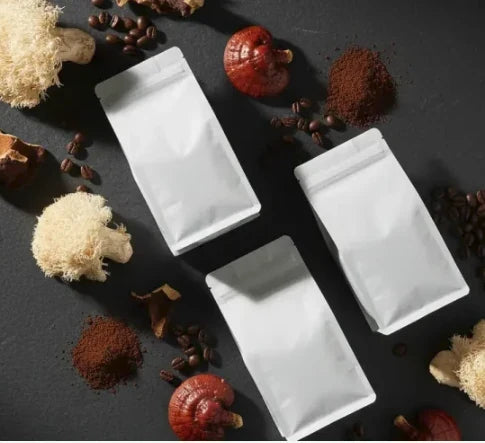
A functional food is a conventional food product — a drink, a snack, a powder you stir into a recipe — that has been enriched or formulated with added ingredients. Mushroom coffee is a functional food. So is a protein bar with added vitamins, or a juice with added probiotics.
There is no standalone EU regulation that defines "functional food" as a legal category. These products are regulated as regular foods under the General Food Law (Regulation EC 178/2002). They must comply with food information rules, but they don't have the same dosing, labelling, or classification requirements as supplements.
Why does this matter for mushroom products?
Because the amount of extract in the product determines whether it can do anything meaningful. But there's a deeper issue that most consumers never hear about: the type of extraction a product is allowed to use.
A typical mushroom coffee contains between 250mg and 500mg of mushroom extract per serving, blended with coffee. That extract has already been diluted, and it's delivered in hot water, which means you're relying on whatever survives the brewing process.
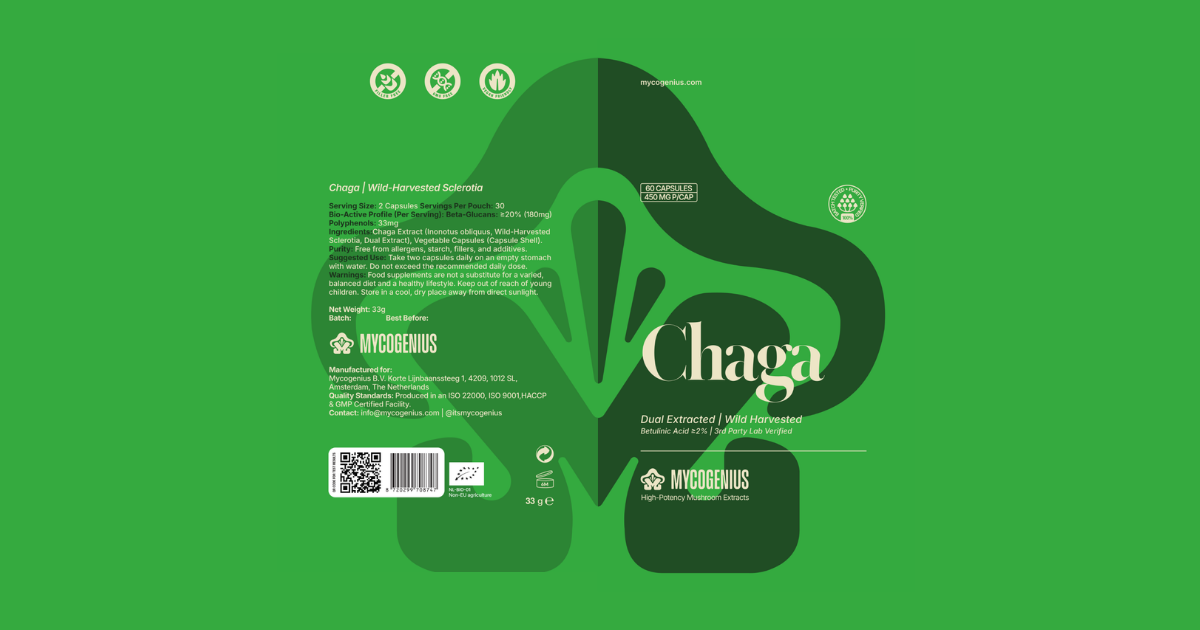
A food supplement capsule delivers a measured dose — in our case, 450mg per capsule, two capsules per day, 900mg total — of extract specifically processed to concentrate the compounds researchers study. No dilution. No heat degradation from brewing. No guesswork about how much you're actually getting.
The published research on functional mushrooms consistently uses extract doses in the range of 750mg to 3,000mg per day. A single cup of mushroom coffee does not come close to the lower end of that range.
The extraction problem nobody talks about
This is where the difference between supplements and functional foods becomes most significant.
Many of the bioactive compounds researchers study in functional mushrooms are not water-soluble. Beta-glucans dissolve in hot water. But triterpenes like the ganoderic acids in Reishi, the hericenones in Lion's Mane, and betulinic acid and sterols in Chaga require ethanol (alcohol) extraction. A water-only extract simply does not pull these compounds out in meaningful quantities.
That's why serious mushroom extracts use dual extraction: hot water first for polysaccharides and beta-glucans, then ethanol for the non-water-soluble compounds. It's two separate processes targeting two different classes of bioactive molecules.
Here's the problem for functional foods: dual extracts — specifically the ethanol extraction step — are not clearly established as Novel Food compliant for most mushroom species. The Novel Food catalogue and existing authorisations largely cover water-based extracts and traditional preparations. An ethanol-extracted mushroom ingredient used in a food product enters uncertain regulatory territory.
The result is that functional food products — your mushroom coffees, chocolates, and drink mixes — are effectively limited to water-only extracts. They can deliver beta-glucans, but they're missing the other half of the bioactive profile that the research literature actually focuses on.
Food supplements, classified and regulated under Directive 2002/46/EC, have more flexibility in the extraction methods they can use. Dual extraction is standard practice in the supplement industry. This is not a loophole. It's a consequence of how the two categories are regulated differently.
For species like Reishi, where the ganoderic acids are among the most studied compounds, or Lion's Mane, where hericenones and erinacines are the focus of cognitive research, a water-only extract is delivering an incomplete product. You're getting polysaccharides, but you're missing the specific compounds that make each species distinct.
Novel Food regulations add another layer
Under EU Regulation 2015/2283, any food or food ingredient that was not consumed significantly within the EU before May 1997 requires a Novel Food authorisation before it can be sold.
This applies to both supplements and functional foods. But it's particularly relevant for mushroom products because some species have Novel Food status and some don't. The distinction depends on the species, the part of the organism used (fruiting body vs mycelium), and the extraction method.
Chaga (Inonotus obliquus) and Cordyceps, for example, are not clearly authorised for use as food ingredients in the EU. Their history of consumption before 1997 is not well-documented in a European food context, which puts them in a regulatory grey area. This applies to all Cordyceps species and strains, including CS-4. A functional food brand putting Chaga or Cordyceps into a coffee or chocolate faces a serious compliance question that most simply ignore.
This compounds the extraction problem. Even for species that are permitted in food use, functional food products are limited to water extracts. So you have species-level restrictions narrowing what you can use, and extraction-method restrictions narrowing what you can extract from whatever you are allowed to use. The result is a product that's constrained on both fronts.
Any company selling mushroom products in the EU needs to verify the Novel Food status of every ingredient. This applies whether you're selling capsules or coffee.
Why Mycogenius chose the food supplement route
We're often asked why we don't make mushroom coffee, mushroom chocolate, or mushroom drinks. The answer comes down to two things: dose and extraction.
Functional food formats can't deliver enough extract to be meaningful, and they're restricted to water-only extraction. That means they're missing the non-water-soluble compounds — the triterpenes, the hericenones, the ganoderic acids — that make each mushroom species worth taking in the first place.
Our focus is on delivering concentrated, species-specific, dual-extracted mushroom extracts at doses consistent with those used in published research. That requires a supplement format — capsules or pure powder with a measured scoop — where the dose is controlled, consistent, and verifiable.
Every batch is independently tested in ISO 17025-accredited laboratories. We publish the full Certificate of Analysis for every batch on our website. That level of transparency is only possible when you control the dose and know exactly what's in each serving.
We're not against mushroom coffee as a product category. If someone enjoys the taste and views it as a food, that's their choice. But we think it's important that consumers understand what they're buying. A functional food with a small amount of water-extracted mushroom powder is not the same as a dual-extracted, concentrated extract in a measured dose.
The bottom line
Food supplements and functional foods serve different purposes. One is designed to deliver specific compounds at specific concentrations using the most effective extraction methods available. The other is a food product with added ingredients, limited to water-based extracts that capture only part of the bioactive profile.
We chose the supplement route because it's the only format that lets us use dual extraction, control the dose, verify the contents, and publish the results. That's what our customers expect, and it's the standard we hold ourselves to.
Get the Dosage & Timing Cheat Sheet
Exact amounts and best timing for all six species, on one page. Free PDF, straight to your screen.
Something went wrong; please try again.
You'll also get our occasional research-based newsletter. Unsubscribe any time.
Done. Here's your cheat sheet.
We've also emailed you a copy so you can find it later.
Download the PDFMycogenius Organic Mushroom Extracts
Species-specific potency verified. Third-party tested in ISO 17025 labs. Batch COAs published.
★★★★★ 4.7 on Trustpilot
Shop All Extracts