Three Things to Look for on a Mushroom Supplement Label Before You Buy
I pick up mushroom supplements whenever I see them. In shops, at trade shows, online. Not to buy them, just to read the label.
Most of them say the same things. Organic. Natural. Beta-glucans. A number that sounds impressive. A nice photo of a mushroom. But almost none of them tell you what is actually inside the capsule, how it got there, or how to verify it.
At this year's World Mushroom Forum, I was on a panel when someone asked, "What are the three most important things a consumer should see on a label?" Three things that tell you whether the product is real.
I have been making mushroom extracts for years. I run both a consumer brand and a B2B supply business. I see what other brands test for, and what they choose not to. Here is what I look for.
1. Species-Specific Quality Markers, Quantified
Every mushroom species has its own signature compounds, the molecules that research is actually studying. They should be on the label with a number next to them.
For Lion's Mane, that means diterpenes. For Reishi, ganoderic acids. For Cordyceps, cordycepin. For Chaga, betulinic acid. And for any species, beta-glucan content should be stated as a verified percentage, not a vague "rich in polysaccharides."
A label that just says "500mg Lion's Mane extract" tells you nothing about what is in that 500mg. It could be a genuine fruiting body extract with verified compounds. It could be steam-treated powder with nothing measurable in it. The weight tells you how much is in the capsule. It tells you nothing about what that stuff is.
I have seen this first-hand. When independent researchers ran NMR spectroscopy on commercial mushroom supplements, some showed over 80% filler. The beta-glucan number on the front of the packaging looked fine. But the standard beta-glucan test (Megazyme) cannot distinguish between real fungal beta-glucans and cheap polysaccharide additives like polydextrose. So the number passes, but the product is mostly filler.
The only way to know what is really inside is to test for species-specific markers, not just a generic polysaccharide count.
What to look for: The specific compounds relevant to that species, quantified on the label. Not just "beta-glucans" in isolation, and not just a weight.
2. Extraction Method Stated
This is the one that surprises most people.
A mushroom extract and mushroom powder are not the same thing. Extraction is the process that concentrates the bioactive compounds. Powder is just dried, ground mushroom. The label should tell you which one you are holding.
Hot-water extraction pulls out beta-glucans and polysaccharides. Ethanol extraction pulls compounds like triterpenes, ganoderic acids, and hericenones, things that are not water-soluble. Dual extraction uses both methods to capture a broader range of compounds.
Here is the problem: many products labelled "extract" have never actually been extracted. Steam sterilisation, a basic hygiene step applied to raw materials, is presented as extraction. It is not. Sterilisation kills bacteria. Extraction concentrates bioactive compounds using solvents over hours. They are completely different processes, but they end up being described the same way on the label.
If a label says "mushroom extract" but does not tell you the extraction method, you have no way of knowing whether anything was actually extracted. And if it was, you do not know what compounds the process was designed to capture.
What to look for: The extraction method is clearly stated: hot water, ethanol, or dual extraction. If the label does not mention extraction at all, it is most likely dried mushroom powder in a capsule.
A Note on Organic Certification
We were hesitant about organic certification for a long time. On its own, it is not a marker of potency or extract quality. An organic product can still be poorly extracted, contain no measurable bioactives, and pass every organic audit without issue.
What changed our thinking was the supply chain traceability it entails. Organic certification means the entire chain, from the cultivation substrate to the extraction facility to the finished product, has been independently inspected. It adds a layer of assurance that the product is free from pesticides, herbicides, and chemical contaminants. Not because we think our product would fail without it, but because it gives you one more thing you can verify independently.
It is not a substitute for species-specific testing or a Certificate of Analysis. But it is another piece of the traceability picture, and that is why we pursued it.
3. Batch Traceability: A Direct Link to the Certificate of Analysis
This is the part most brands skip, and it is the most important.
A Certificate of Analysis is the document that proves what is in the product. It should come from an independent, ISO 17025-accredited laboratory and be available for the specific batch you are holding in your hand.
I have asked brands for COAs. Some have a generic quality page on their website that does not reference any specific batch. Some will send you a PDF if you email and ask, but you have no way of knowing if that document relates to the product you bought or a batch from two years ago. A few publish nothing at all.
Batch-level traceability means a QR code or batch reference on the packaging that links directly to the COA for that specific production run. Not a supplier COA from before the product was even made. Not a generic document covering a range of products. The finished product, tested after production, verified by a lab with no commercial relationship to the brand.
Pharmaceutical products are held to this standard. There is no reason food supplements should be any different. The technology exists. The cost is not prohibitive. Most brands just choose not to do it.
What to look for: A QR code, batch number, or direct link on the packaging that takes you to the actual test results for that batch. If the brand cannot produce a COA for the batch you bought, you do not know what you are taking.
The Three-Point Check
You do not need a degree in mycology to spot a good mushroom supplement. You need three things on the label:
- What is in it, species-specific quality markers, quantified
- How it was made, the extraction method, stated clearly
- Proof: a direct link to the batch-specific Certificate of Analysis
Next time you pick up a mushroom supplement, check for all three. Most products will have one at best. If a product has none of them, the label is decoration.
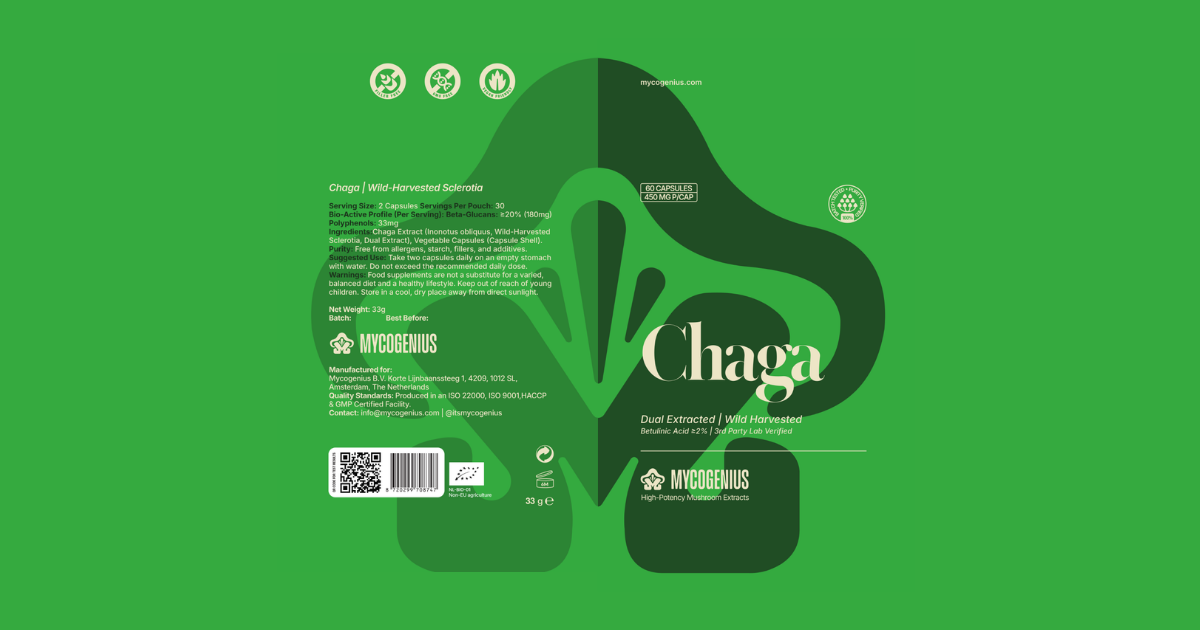
This is why we built Mycogenius the way we did. Every product carries species-specific markers on the label. Every product states the extraction method. Every pouch has a QR code linking to the full Certificate of Analysis for that batch, which was tested by an independent ISO 17025-accredited lab. We publish every result because we think that should be the baseline, not the exception.
Scan the code. See what is inside.
Get the Dosage & Timing Cheat Sheet
Exact amounts and best timing for all six species, on one page. Free PDF, straight to your screen.
Something went wrong; please try again.
You'll also get our occasional research-based newsletter. Unsubscribe any time.
Done. Here's your cheat sheet.
We've also emailed you a copy so you can find it later.
Download the PDFMycogenius Organic Mushroom Extracts
Species-specific potency verified. Third-party tested in ISO 17025 labs. Batch COAs published.
★★★★★ 4.7 on Trustpilot
Shop All Extracts