We Tested 30 Lion's Mane Supplements. Here's What We Found.
The mushroom supplement market is growing fast. That is not news. What might be news is how little of what you are buying actually contains the compounds you are paying for.
We wanted to know. Not in the way brands usually "want to know," which involves quoting their own supplier's certificate of analysis and calling it transparency. We wanted independent data. From a scientist. Testing finished products off the shelf, the same ones you or I would buy.
So we commissioned a study. Here is what came back.
The Study
Working with Emma Murphy, senior business development scientist at Shannon ABC, Technological University of the Shannon (TUS), and with funding from Enterprise Ireland, we tested 30 commercially available lion's mane supplements sold across the EU and UK.
The samples were purchased the same way a consumer would. No advance notice to any brand. No cherry-picked batches. Just 30 products pulled from the market and sent to the lab.
Each sample was tested for three categories of compounds:
- Beta-glucans: the large polysaccharide molecules that form the structural backbone of mushroom cell walls and are widely considered the primary bioactive compounds in mushroom extracts.
- Hericenones C and D: neuroactive compounds unique to lion's mane, found primarily in the fruiting body. These are the compounds most commonly cited when people talk about lion's mane and cognitive function.
- Triterpenes: a broad class of secondary metabolites that contribute to the extract's overall compound profile.
The testing was conducted at an independent laboratory. We had no control over the results and no ability to influence them. That was the point.
The Results
Beta-glucans: 5% to 82%
Beta-glucan content across the 30 samples ranged from below 5% to 82%.
To put that in context: a genuine lion's mane fruiting body extract typically contains between 30% and 40% beta-glucans. That is the expected range when you properly extract from real fruiting body material.
A reading below 5% means the product is essentially inert. Not a supplement. A capsule filled with starch, grain, or ground-up mushroom biomass that has never been properly extracted. You would get more bioactive content from a slice of bread.
A reading of 82% is equally problematic, but for a different reason. That figure is too high for a genuine fruiting body extract. It is a strong indicator of manipulation or adulteration; likely the addition of purified beta-glucan from a cheaper source (such as yeast or oat) to inflate the number on the certificate of analysis. It looks impressive on a label. It is not what it claims to be.
Hericenones: undetectable in all 30
This was the most striking finding.
Hericenones C and D were not detected in any meaningful concentration in any of the 30 samples. Not some of them. All 30.
These are the compounds most people are buying lion's mane for. They are the reason lion's mane gets discussed in the context of nerve growth factor and cognitive function. And in a test of 30 products from the European market, none contained a measurable amount.
There are a few possible explanations. The most likely is that the products were not properly extracted, or were made from mycelium-on-grain rather than fruiting body. Hericenones are found primarily in the fruiting body of lion's mane, and they require specific extraction conditions to isolate. Simply grinding up raw mushroom material and putting it in a capsule will not get you there.
Another factor is harvest timing. The concentration of bioactive compounds varies significantly with the duration the mushroom is allowed to grow. A fruiting body harvested at five months will have a very different compound profile from one harvested at nine or eleven months.
Triterpenes: 2 out of 30
Triterpenes were detected across multiple samples, but only two out of 30 returned identification scores indicating high confidence in their presence.
This means 28 of the 30 products either contained trace amounts below the threshold of reliable detection, or contained other compounds that were being misidentified.
We make this extract. Organic Lion's Mane, third-party tested, full COA published.
Shop Lion's Mane →What This Tells You
The pattern across all three compound categories is consistent: the majority of lion's mane supplements on the EU and UK market do not contain what they claim to contain.
This is not a fringe finding. More than half the products tested failed to meet their own label claims. Several contained little to no detectable active compounds whatsoever.
The problems fall into two categories.
The first is upstream. Growing conditions, harvest timing, and extraction methods all determine the final compound profile of the extract. A product grown on grain in laboratory conditions, harvested early, and subjected to steam treatment (which is not the same as proper extraction) will produce a fundamentally different result from a product grown on hardwood, harvested at maturity, and dual-extracted. Both can legally be called "lion's mane extract." They are not the same product.
The second is labelling. Many brands quote extraction ratios such as 10:1 or 15:1. These sound impressive but are unverifiable without independent testing of the actual quality markers. A 10:1 extract that has not been tested for hericenones, beta-glucans, or triterpenes is just a number on a label.
Similarly, the phrase "third-party tested" has lost most of its meaning. In many cases, this means the raw material supplier provided their own certificate of analysis, which the brand then republished. The supplier is testing their own product. That is not third-party testing. That is a conflict of interest.
What We Do Differently
We are not pretending to be neutral observers here. We funded this research because we believed the results would confirm what we had seen in the market for years, and they did.
At Mycogenius, every batch we sell is tested by an independent, ISO 17025-accredited laboratory. Not our supplier's lab. An independent one, with the lab's name on the report, testing the finished product you actually receive. You can see our full testing methodology on our testing transparency page.
We publish full certificates of analysis on our website, and every product ships with a QR code on the packaging that links directly to the lab report for that specific batch. If the report is not there, the product does not ship.
Our lion's mane is grown on hardwood sawdust, harvested at maturity, and dual-extracted from 100% fruiting body. Our supplier goes further than standard dual extraction, applying chromatographic purification steps that isolate and concentrate the specific bioactive compounds.
We are not saying this to sell you a product. We are saying it because the data shows that the majority of what is on the market does not do what it claims. And if you are spending money on a lion's mane supplement, you deserve to know that. For a detailed breakdown of what to look for, see our guide to the best lion's mane supplements.
How to Protect Yourself
Regardless of which brand you buy, here is how to check whether your supplement contains what it says it does:
- Ask for the batch-specific COA. Not a generic one from the website. The certificate of analysis for the exact batch you are purchasing. If a brand cannot provide this, that tells you everything.
- Check who did the testing. The lab should be named on the report. It should be an ISO 17025-accredited laboratory, not the supplier's own facility. Look for names like Eurofins, Alkemist Labs, or Omnient Labs.
- Look for species-specific markers. A meaningful COA for lion's mane should test for beta-glucans, hericenones, and ideally triterpenes. If the report shows heavy metals and microbial contamination, it indicates the product met basic safety requirements. It does not tell you it contains any bioactive compounds.
- Be sceptical of extreme numbers. Beta-glucan content above 50% in a fruiting body extract is a red flag. So is an extraction ratio of 15:1 or 20:1 with no accompanying lab data to verify it.
- Check the source material. Fruiting body and mycelium-on-grain are not interchangeable. If the label does not specify, assume the worst.
The Full Research
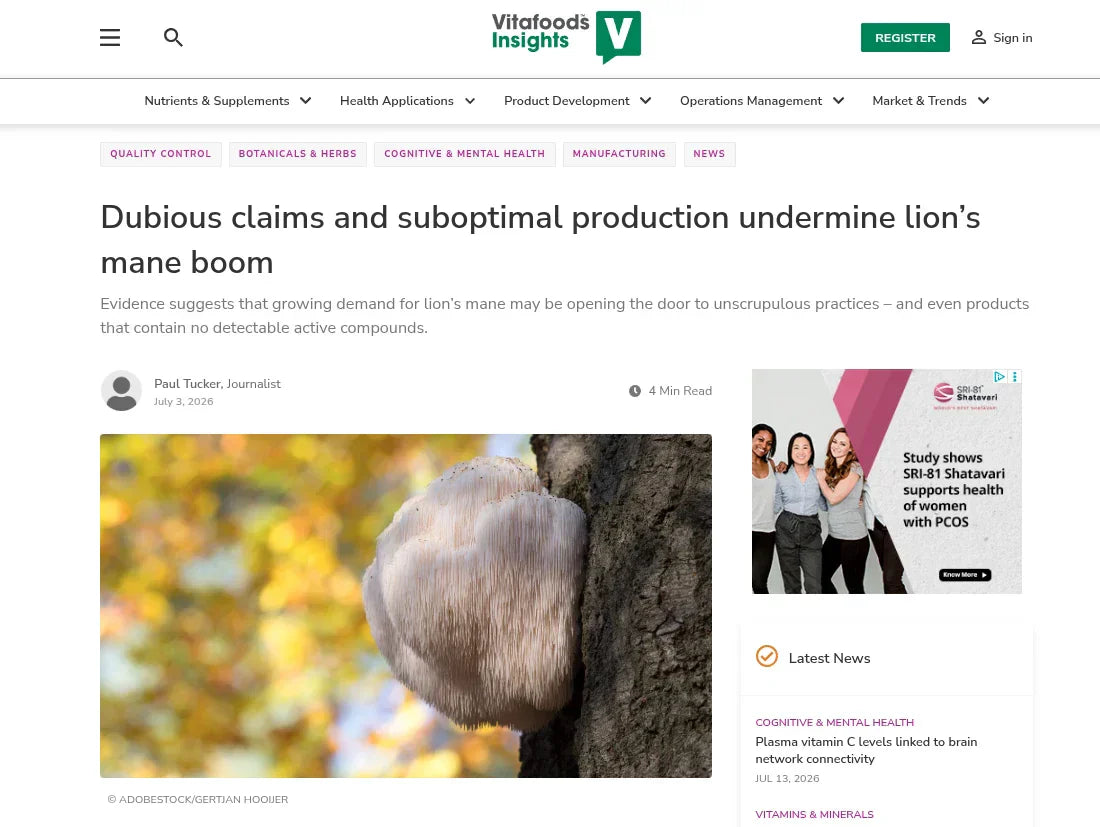
The study findings have been published in Vitafoods Insights (July 2026), and we discussed the broader transparency challenges with NutraIngredients (May 2026).
The raw data and methodology are available on request. If you are a researcher, journalist, or brand that wants access, get in touch.
Ready to try Lion's Mane?
Organic 1:1 extract. Verified diterpenes and beta-glucans. ISO 17025 third-party tested.
Shop Lion's ManeFrequently Asked Questions
Who conducted this study?
The study was conducted by Emma Murphy, senior business development scientist at Shannon ABC, Technological University of the Shannon (TUS), in collaboration with Mycogenius and with funding from Enterprise Ireland. The testing was performed at an independent laboratory on 30 commercially available lion's mane supplements purchased from the EU and UK market.
Why were hericenones not detected in any of the 30 samples?
Hericenones C and D are found primarily in the fruiting body of lion's mane and require proper extraction to isolate. Products made from mycelium-on-grain, harvested early, or subjected to steam treatment rather than genuine extraction are unlikely to contain measurable hericenone levels. The absence across all 30 samples suggests a widespread reliance on inferior source material or extraction methods.
What does a beta-glucan reading of 82% indicate?
A genuine lion's mane fruiting body extract typically contains between 30% and 40% beta-glucans. A reading of 82% exceeds what is naturally achievable from lion's mane. It is a strong indicator of adulteration, most likely the addition of purified beta-glucan from a cheaper source such as yeast or oat to inflate the lab results.
How can I verify the quality of a lion's mane supplement?
Ask the brand for a batch-specific certificate of analysis from an ISO 17025-accredited independent laboratory. The report should test for species-specific bioactive markers, including beta-glucans, hericenones, and triterpenes, rather than just basic safety metrics such as heavy metals and microbial contamination.
Does Mycogenius publish its own lab results?
Yes. Every Mycogenius product ships with a QR code on the packaging that links to the full certificate of analysis for that specific batch. Lab reports are also published on the Mycogenius website. Independent, ISO 17025-accredited laboratories perform all testing.
What is the difference between fruiting body and mycelium-on-grain?
The fruiting body is the mature mushroom itself and contains the highest concentrations of bioactive compounds, including hericenones and beta-glucans. Mycelium-on-grain (MOG) is fungal mycelium grown on a grain substrate such as rice or oats. The grain is typically not removed before processing, diluting the active compounds with starch that has no functional relevance.
Get the Dosage & Timing Cheat Sheet
Exact amounts and best timing for all six species, on one page. Free PDF, straight to your screen.
Something went wrong; please try again.
You'll also get our occasional research-based newsletter. Unsubscribe any time.
Done. Here's your cheat sheet.
We've also emailed you a copy so you can find it later.
Download the PDFMycogenius Lion's Mane Extract
Organic fruiting body extract. Beta-glucans ≥35%. Third-party tested, batch COA published.
★★★★★ 4.7 on Trustpilot
Shop Lion's Mane