What Are Beta-Glucans? How Mushroom Polysaccharides Work
You have probably seen beta-glucan numbers printed on mushroom supplement labels. "50% beta-glucans." "60% beta-glucans." Maybe even higher. You would be forgiven for thinking that bigger numbers always mean better products. That is exactly what most brands want you to believe.
But a beta-glucan number, on its own, tells you almost nothing about what is actually in the product. Not because beta-glucans do not matter — they do, enormously — but because the way they are measured has a fundamental blind spot. One that some producers have learned to exploit.
You deserve to understand what beta-glucans actually are, how your body recognises them, and why a label claiming 60% might contain less genuine fungal beta-glucan than one claiming 30%.
What Beta-Glucans Actually Are
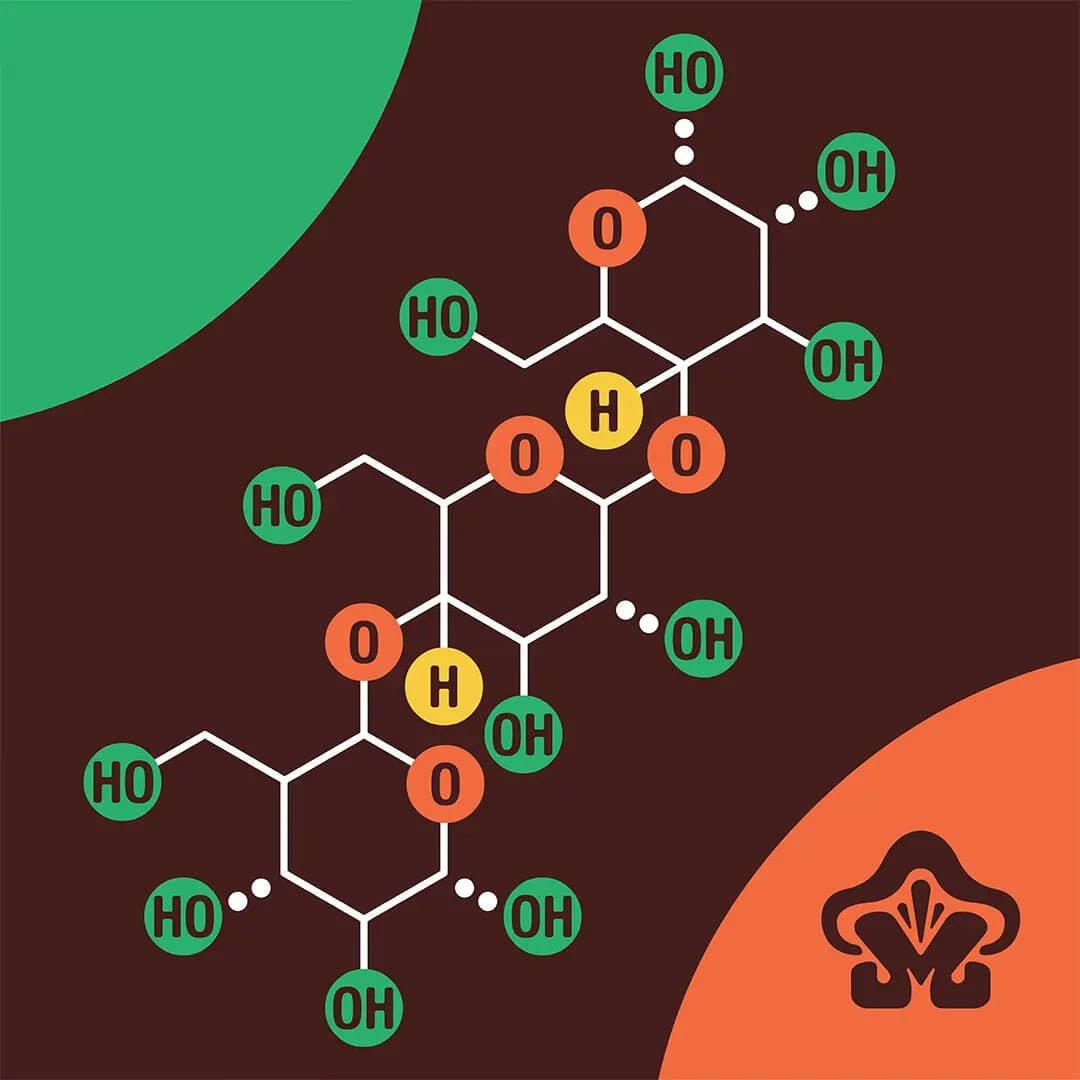
Beta-glucans are polysaccharides — long chains of glucose molecules linked together by a specific type of chemical bond: a beta-glycosidic linkage.
That bond matters. It is the structural difference between a beta-glucan and starch. Starch uses alpha-linkages — your digestive enzymes break it down rapidly into sugar. Beta-glucans resist digestion entirely. They pass through the upper gastrointestinal tract intact, which is precisely what makes them biologically interesting.
But not all beta-glucans are the same molecule. The glucose chains can be linked at different positions — (1,3), (1,4), or (1,6) — and branch in different patterns. This branching structure distinguishes one type from another and determines how the body responds.
Mushroom beta-glucans have a backbone of (1,3)-linked glucose units with (1,6)-linked side branches. This particular architecture — the (1,3)(1,6) branching pattern — is found almost exclusively in fungi.
Cereal beta-glucans (from oats and barley) use a (1,3)(1,4) backbone with no branching. These are the beta-glucans associated with cholesterol-related EFSA health claims. They are structurally quite different from fungal beta-glucans.
Yeast beta-glucans share the (1,3)(1,6) branching with mushrooms, but their molecular weight and branching density differ, meaning the body interacts with them differently.
The point is this: calling something a "beta-glucan" is a bit like calling something a "protein." It tells you the broad category, not the specific molecule. When a mushroom supplement label says "40% beta-glucans," it does not specify which structural type those beta-glucans are — and that distinction matters more than the percentage.
This matters because the EFSA-approved health claim linking beta-glucans to cholesterol applies specifically to cereal (1,3)(1,4)-beta-glucans at a dose of 3g per day. It does not extend to mushroom beta-glucans. Any brand implying otherwise is either confused or dishonest. And yeast beta-glucans, while sharing the (1,3)(1,6) branching, differ in particle size and molecular weight — research on yeast-derived beta-glucans cannot be directly transferred to mushroom-derived forms.
Mushroom beta-glucans sit in their own category. They come bundled within a complex matrix of other bioactive compounds — triterpenes, diterpenes, sterols, phenolic compounds — that vary by species. A Reishi extract contains ganoderic acids alongside its beta-glucans. A Lion's Mane extract contains hericenones. A Chaga extract contains betulinic acid. These secondary metabolites are part of what makes each species distinct, and why beta-glucan content alone is an incomplete measure of quality.
How Your Body Recognises Mushroom Beta-Glucans
Your body has been dealing with fungi for as long as mammals have existed. Over hundreds of millions of years, the innate part of your biology developed pattern recognition receptors specifically tuned to detect fungal structures.
The key receptor is called Dectin-1. It sits on the surface of certain cells and recognises the (1,3)(1,6)-beta-glucan branching pattern. When a beta-glucan molecule with this architecture binds to Dectin-1, it triggers a signalling cascade inside the cell. Think of it like a lock and key. The (1,3)(1,6) structure is the key. Dectin-1 is the lock. Cereal beta-glucans, with their (1,3)(1,4) structure, do not fit.
There is another receptor worth knowing about: Complement Receptor 3 (CR3), which recognises smaller beta-glucan fragments. Together, Dectin-1 and CR3 form the primary recognition system through which the body detects and responds to fungal polysaccharides. The core insight is simple: your body does not process mushroom beta-glucans like food. It recognises them as a signal.
The molecular weight and degree of branching directly influence how strong that signal is. Higher molecular weight, more complex branching — generally stronger receptor binding. This is why extraction method matters: poorly extracted products may contain some beta-glucans, but if those molecules have been degraded during processing, they may not engage the same receptors as intact, high-molecular-weight polysaccharides from a properly extracted fruiting body.
How Beta-Glucan Testing Works — And Where It Breaks Down
The industry standard for measuring beta-glucans in mushroom products is the Megazyme K-YBGL assay (Yeast and Mushroom Beta-Glucan method). Here is how it works in simplified terms:
- The sample is analysed for total glucan content — all polysaccharides present.
- A separate test measures alpha-glucan content — primarily starch and glycogen.
- Beta-glucan content is calculated as: Total glucans minus alpha-glucans.
This is a subtraction method. It does not directly measure beta-glucans. It measures everything, subtracts the starch fraction, and calls whatever remains "beta-glucan."
For a genuine, clean mushroom extract with no additives, this method works reasonably well. The subtraction gives you a meaningful approximation.
But the method has a vulnerability. It assumes that the only polysaccharides present in the sample are fungal beta-glucans and starch. Suppose there is a third type of polysaccharide in the mix — one that is neither a beta-glucan nor an alpha-glucan — the Megazyme method has no way to distinguish it. That third polysaccharide gets counted as beta-glucan by default.
This is not a hypothetical problem. It is the basis of an adulteration strategy that has spread across the global mushroom supplement supply chain.
The Polydextrose Problem
Polydextrose is a synthetic polysaccharide manufactured from glucose, sorbitol, and citric acid. It is cheap, widely available, and classified as a food additive. It has no relevance to mushroom supplementation whatsoever.
But when polydextrose is added to a mushroom product, it inflates the beta-glucan reading on the Megazyme assay. Polydextrose is not an alpha-glucan, so it does not get subtracted. It is not a (1,3)(1,6)-beta-glucan either, but the assay cannot distinguish between them. It falls into the "everything else" category — the number reported as beta-glucan content.
A product with 15% genuine fungal beta-glucans can register as 55% or 60% if enough polydextrose is added. The label looks exceptional. The price stays low. The consumer has no way of knowing.
We share this data not to scare anyone, but because it is the single biggest quality issue in the mushroom supplement market today. In Enterprise Ireland-funded testing of European market samples, 72% of products analysed were found to have no meaningful bioactive value. Polysaccharide fillers were identified as a primary driver.
The motive is straightforward. Genuine dual extraction is expensive — Lion's Mane fruiting body, for instance, requires ethanol extraction first for the heat-sensitive diterpenes, followed by hot water extraction for polysaccharides. That is a multi-step, hours-long process. Adding polydextrose to a steam-treated powder costs almost nothing and produces a higher number on the same test.
What a Meaningful Beta-Glucan Number Looks Like
If the standard assay can be gamed, what should you actually expect from a genuine product?
For a properly dual-extracted fruiting body extract — one that has gone through genuine hot water and ethanol extraction, with no fillers or bulking agents — beta-glucan content typically falls in the range of 25% to 40%. This varies by species, growing conditions, extraction parameters, and batch.
That range might seem modest compared to the 50%+ claims on some labels. That is precisely the point. When you see a number above 50%, it should prompt questions rather than confidence. A fruiting body is a complex organism — where are the triterpenes, the sterols, the phenolic compounds? A genuine extract should reflect that complexity.
Here is a rough guide:
- Below 15%: Likely not a genuine extract. May be ground mushroom powder, mycelium-on-grain, or a very low-quality product.
- 15%–25%: Possible single-method extraction (hot water only, for instance) or a product where growing conditions were suboptimal.
- 25%–40%: The expected range for a properly extracted fruiting body product. This is what quality looks like when the testing is honest.
- Above 50%: Raises questions. Could be a highly concentrated isolate (rare and expensive), but far more commonly indicates the presence of polysaccharide fillers that are inflating the assay result.
These ranges are not absolute rules. They are guidelines based on what real-world, verified testing data looks like when analysed using methods that can actually distinguish genuine beta-glucans from fillers.
NMR: The Method That Cannot Be Fooled
If the Megazyme assay has a blind spot, Nuclear Magnetic Resonance (NMR) spectroscopy closes it.
NMR does not measure beta-glucans by subtraction. It reads the molecular fingerprint of a sample — the actual chemical structures present, their ratios, and their identities. When an NMR spectrometer analyses a mushroom extract, it produces a spectral profile that can be compared against verified reference standards. If polydextrose is present, it shows up as a distinct molecular signature. If the mushroom species is wrong, the NMR profile will not match the reference. There is no way to fake it.
Purity-IQ, a laboratory based in Vancouver, Canada, has developed NMR metabolomic analysis specifically for the mushroom supplement category. When they analysed anonymised commercial samples, the data revealed polydextrose, species misidentification, and compound profiles inconsistent with label claims — findings the standard enzymatic assay would have missed entirely.
NMR is expensive, and most brands will never commission it. But its existence establishes a benchmark: when a company has NMR-verified data, you know the numbers are real. When they do not, you are relying on a test that can be manipulated.
At Mycogenius, our products are third-party tested in ISO 17025-accredited laboratories, with batch-specific Certificates of Analysis published for every product. We use the Megazyme K-YBGL method for beta-glucan quantification — but critically, our extracts contain no fillers, no bulking agents, and no polydextrose, which means the assay is measuring what it was designed to measure: genuine fungal polysaccharides from real fruiting body extracts.
What to Look for When You Buy
If you are choosing a mushroom supplement, beta-glucan content is a useful data point — but only when combined with context. Here is what to check:
- Fruiting body extract or mycelium-on-grain? Fruiting body extracts contain higher concentrations of both beta-glucans and species-specific compounds. Mycelium-on-grain products contain a significant amount of grain starch, which dilutes the bioactive fraction.
- Batch-specific Certificates of Analysis? Not a generic "third-party tested" badge, but actual COAs showing beta-glucan content, alpha-glucan content, heavy metals, and species-specific marker compounds.
- Beta-glucan number in a realistic range? For fruiting body extracts, 25%–40% is typical. Numbers well above 50% without clear explanation deserve scrutiny.
- Species-specific compounds present? Ganoderic acids for Reishi, diterpenes for Lion's Mane, cordycepin for Cordyceps, betulinic acid for Chaga. If the only number on the label is beta-glucans, the company is either not testing for these compounds or not finding them.
- Extraction method specified? Dual extraction captures both water-soluble polysaccharides and alcohol-soluble compounds. Single-method extraction misses half the picture.
Frequently Asked Questions
What are beta-glucans in mushrooms?
Beta-glucans are polysaccharides — chains of glucose molecules connected by beta-glycosidic bonds. Mushrooms have a characteristic (1,3)(1,6)- branched structure that distinguishes them from cereal or yeast beta-glucans. They are among the primary bioactive compound groups found in functional mushroom extracts and are recognised by specific pattern-recognition receptors in the body, particularly the Dectin-1 receptor.
How are beta-glucans in mushroom supplements tested?
The industry standard is the Megazyme K-YBGL (Yeast and Mushroom Beta-Glucan) assay. This method measures total glucans, then subtracts alpha-glucans (starch and glycogen) to arrive at a beta-glucan figure. While effective for clean samples, this subtraction method cannot distinguish genuine fungal beta-glucans from non-alpha-polysaccharide fillers such as polydextrose. NMR (Nuclear Magnetic Resonance) spectroscopy offers a more definitive analysis by directly reading the molecular fingerprint of a sample.
What is a good beta-glucan percentage in a mushroom supplement?
For a genuine dual-extracted fruiting body extract with no fillers, beta-glucan content typically falls between 25% and 40%, depending on the species and extraction parameters. Numbers significantly above 50% should be questioned rather than celebrated, as they often indicate the presence of polysaccharide fillers that inflate the standard assay result. A realistic beta-glucan number paired with verified species-specific compounds is a far stronger quality indicator than a high percentage alone.
Are mushroom beta-glucans the same as oat beta-glucans?
No. Oat beta-glucans have a (1,3)(1,4) linear structure, while mushroom beta-glucans have a (1,3)(1,6) branched structure. This structural difference means they interact with different receptors in the body and produce different biological responses. The EFSA-approved health claim for beta-glucans and cholesterol applies specifically to cereal beta-glucans at 3g per day — it does not extend to mushroom-derived beta-glucans.
How does polydextrose inflate beta-glucan test results?
Polydextrose is a synthetic polysaccharide made from glucose, sorbitol, and citric acid. When added to a mushroom product, it inflates the beta-glucan reading on the standard Megazyme assay because the test works by subtraction: total glucans minus alpha-glucans equals beta-glucans. Polydextrose is not an alpha-glucan, so it is not subtracted — it gets counted as beta-glucan by default, even though it has no relevance to mushroom bioactivity. NMR analysis is currently the most reliable method to detect this type of adulteration.
Disclaimer: This article is for informational purposes only. The statements made in this article have not been evaluated by any regulatory authority. Functional mushroom supplements are not intended to diagnose, treat, cure, or prevent any disease. Always consult a qualified healthcare professional before starting any supplement regimen. No EFSA-authorised health claims currently exist for any mushroom species referenced in this article.
Get the Dosage & Timing Cheat Sheet
Exact amounts and best timing for all six species, on one page. Free PDF, straight to your screen.
Something went wrong; please try again.
You'll also get our occasional research-based newsletter. Unsubscribe any time.
Done. Here's your cheat sheet.
We've also emailed you a copy so you can find it later.
Download the PDFMycogenius Organic Mushroom Extracts
Species-specific potency verified. Third-party tested in ISO 17025 labs. Batch COAs published.
★★★★★ 4.7 on Trustpilot
Shop All Extracts