Best Cordyceps Supplement: What to Look For in 2026
The best Cordyceps supplement depends on which species you are buying, how it was grown, and whether the extract has been independently tested. Most buyers skip these details entirely and choose based on price or marketing claims. That is a mistake because the Cordyceps supplement market is among the most confusing in the functional mushroom space.
There are two commercially relevant Cordyceps species, grown using completely different methods and with distinct compound profiles. Choosing between them is the single most important decision when buying a Cordyceps product, yet most supplement labels do not make the distinction clear.
This guide covers what to look for, what to avoid, and how to tell whether a Cordyceps supplement is worth your money.
Cordyceps Militaris vs Cordyceps Sinensis: The Essential Distinction
Before comparing brands or prices, you need to understand that "Cordyceps" on a supplement label can refer to two very different organisms:
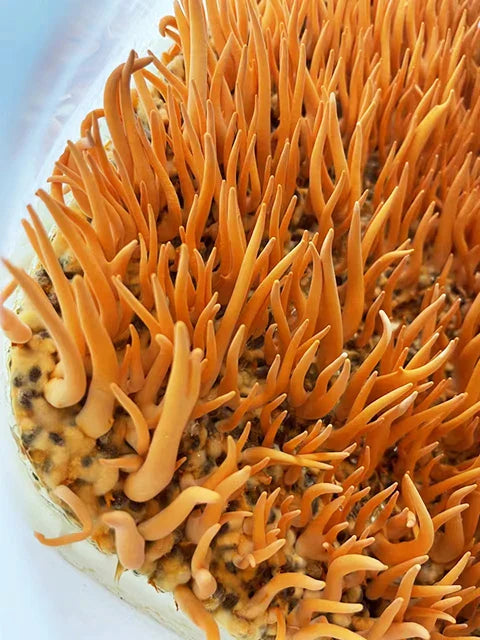
| Cordyceps militaris | Cordyceps sinensis (CS-4) | |
|---|---|---|
| What it is | A species that can be cultivated to produce fruiting bodies on grain or other substrates | A liquid-fermented mycelium strain originally isolated from wild Ophiocordyceps sinensis |
| How it is grown | Solid-state cultivation (typically on rice or grain substrates) in controlled environments | Liquid fermentation in bioreactors (submerged culture), then filtered and dried. |
| Key compounds | Cordycepin (3'-deoxyadenosine), adenosine, polysaccharides, beta-glucans | Adenosine, polysaccharides, beta-glucans, cordycepic acid (D-mannitol) |
| Cordycepin content | Naturally present in fruiting bodies, often at measurable levels | Generally absent or present only in trace amounts. Cordycepin is characteristic of militaris, not sinensis |
| Wild equivalent | Wild C. militaris fruiting bodies (found on insect larvae) | Wild Ophiocordyceps sinensis (the caterpillar fungus, Tibetan highlands, sells for $20,000+ per kilogram) |
| Price range | Moderate (commercially cultivable) | Moderate (liquid fermentation is efficient, but quality CS-4 strains are rarer) |
Why This Matters for Buyers
Neither species is inherently "better" than the other. They are different products with different compound profiles. The problem is when labels say "Cordyceps" without specifying the species or growth method, leaving buyers unable to compare meaningfully.
A few things to watch for:
- "Cordyceps sinensis" on the label does not mean wild caterpillar fungus. Wild O. sinensis is far too rare and expensive for use as a supplement. Any affordable "sinensis" product is almost certainly CS-4 mycelium grown via liquid fermentation. This is not a bad thing, but it should be disclosed clearly.
- Cordyceps militaris grown on grain may contain significant grain starch. If the entire substrate (grain + mycelium) is ground into the final product, the result is a diluted product sometimes called mycelium-on-grain (MOG). Look for products that specify fruiting body or that test and report beta-glucan content, which indicates how much of the product is actually fungal material versus grain filler.
- CS-4 is not a fruiting body product. It is mycelium grown in liquid culture, filtered, and dried. It does not contain grain starch (because it is not grown on grain), but it is also not a fruiting body extract. It is its own category, with a substantial body of research, particularly from Chinese clinical studies conducted since the 1990s.
What Makes a Good Cordyceps Supplement?
Regardless of which species you choose, here are the quality markers to look for:
1. Species and Growth Method Are Clearly Stated
The label should tell you exactly what you are taking. Look for:
- Species name (Cordyceps militaris or Cordyceps sinensis CS-4)
- Which part of the organism (fruiting body, mycelium, or whole organism)
- Growth method (solid substrate, liquid fermentation, or mycelium-on-grain)
If a product says "Cordyceps" or "Cordyceps mushroom blend" without specifying these details, that is a red flag.
2. Extraction Method Is Specified
Raw mushroom material is largely indigestible because the bioactive compounds are locked inside chitin cell walls. Extraction breaks these walls open. Look for:
- Hot water extraction to capture polysaccharides and beta-glucans
- Dual extraction (hot water + ethanol) for the full spectrum of compounds
Products labelled as "raw powder" or "whole mushroom powder" that have not been extracted may have poor bioavailability.
3. Beta-Glucan Content Is Tested and Reported
Beta-glucans are the most studied class of compounds in functional mushrooms. A quality Cordyceps product should list the beta-glucan percentage on the label and have it verified by an independent laboratory.
Be cautious of products that report "polysaccharide" content instead of beta-glucans specifically. Polysaccharide testing can be inflated by starch from grain substrates or by fillers such as polydextrose, which register as polysaccharides in standard assays but are not bioactive fungal compounds.
4. Third-Party Testing at an Accredited Lab
Independent testing by an ISO 17025-accredited laboratory is the minimum standard. The lab should verify:
- Beta-glucan content
- Adenosine content (for CS-4 and militaris)
- Cordycepin content (primarily relevant for militaris)
- Heavy metals, pesticides, and microbial contaminants
Any brand that does not make its Certificates of Analysis accessible should be viewed with caution.
5. No Fillers, No Grain, No Undisclosed Additives
Check the "Other Ingredients" section on the label. Quality Cordyceps supplements should contain the extract and a capsule shell (for capsules), with no maltodextrin, silicon dioxide, rice flour, or other fillers.
CS-4: The Research Behind the Strain
CS-4 deserves its own section because it is often misunderstood. It is not a fruiting body. It is not grown on grain. It is a specific mycelial strain (Paecilomyces hepiali, reclassified as Hirsutella sinensis) originally isolated from wild Ophiocordyceps sinensis specimens on the Tibetan Plateau.
The strain is grown via liquid fermentation (submerged culture in bioreactors), producing a clean mycelial product without grain contamination. This process was developed in China in the 1980s as a sustainable and affordable alternative to wild-harvested caterpillar fungus.
What the Research Shows
CS-4 has been the subject of more clinical research than any other Cordyceps preparation:
- A randomised, double-masked, placebo-controlled trial in 2004 studied CS-4 supplementation in 131 elderly subjects. After 12 weeks, the CS-4 group showed improvements in exercise capacity compared to placebo. Published in the Journal of Alternative and Complementary Medicine, PMID: 15118196.
- Multiple Chinese clinical studies from the 1990s and 2000s examined CS-4 in various contexts, contributing to its approval by the Chinese State Food and Drug Administration.
Note: Many of the Chinese clinical studies on CS-4 have limitations, including small sample sizes and study designs that do not always meet Western clinical trial standards. The evidence is encouraging but not conclusive.
Best Time to Take Cordyceps
Cordyceps does not contain caffeine, but many people prefer taking it in the morning or early afternoon, based on traditional use patterns and anecdotal reports that it is mildly stimulating.
General timing guidance:
| Timing | Rationale |
|---|---|
| Morning, 30-60 minutes before food | Most common recommendation. Allows absorption on a relatively empty stomach. |
| Before exercise | Some athletes take Cordyceps 30-60 minutes before training, following the traditional association with physical endurance. |
| With food | If you experience mild stomach sensitivity, taking Cordyceps with a small meal can help. This may slightly delay absorption but does not significantly affect it. |
| Evening | Less common. Some people report difficulty sleeping when taking Cordyceps late in the day, though this is anecdotal and not established in research. |
Consistency matters more than timing. Taking Cordyceps daily at roughly the same time is more important than optimising the exact hour.
Red Flags: What to Avoid in a Cordyceps Supplement
- "Proprietary blend" without individual ingredient amounts. This makes it impossible to know how much Cordyceps you are actually getting.
- No species identification. If the label says "Cordyceps" without specifying militaris or sinensis, the manufacturer is either being careless or deliberately vague.
- High "polysaccharide" claims with no beta-glucan testing. Polysaccharide numbers can be inflated by starch and fillers. Beta-glucan content is a meaningful measure.
- No third-party testing or COA available. If a brand cannot show you its lab results, do not trust its label claims.
- Mycelium-on-grain without disclosure. This is the biggest quality issue in the mushroom supplement market. The product may contain more grain starch than fungal material.
- Wild Cordyceps sinensis claims at supplement prices. Genuine wild caterpillar fungus costs thousands per kilogram. If a product claims to contain it and costs $30 a bottle, the claim is not credible.
Mycogenius Cordyceps CS-4 Extract
Our Cordyceps uses award-winning CS-4 mycelium, grown via liquid fermentation (no grain substrate). Dual-extracted and third-party tested at an ISO 17025-accredited laboratory. Every batch comes with a published Certificate of Analysis showing verified adenosine and beta-glucan content.
View Cordyceps CS-4 Extract Capsules | View Cordyceps CS-4 Extract Powder
Frequently Asked Questions
What is the best type of Cordyceps supplement?
It depends on what you are looking for. Cordyceps militaris fruiting body extracts contain cordycepin, a compound unique to that species. CS-4 (Cordyceps sinensis mycelium) has a longer history of clinical research, particularly in Chinese studies. Both are legitimate options, but you should know which one you are buying and ensure it has been properly extracted and independently tested.
What is CS-4 Cordyceps?
CS-4 is a mycelium strain originally isolated from wild Ophiocordyceps sinensis (the caterpillar fungus of the Tibetan Plateau). It is produced via liquid fermentation in bioreactors, yielding a clean mycelial product without grain contamination. CS-4 has been the subject of clinical trials and is approved as a medicinal preparation in China.
What is the difference between Cordyceps militaris and Cordyceps sinensis?
Cordyceps militaris is commercially cultivated to produce fruiting bodies and naturally contains cordycepin. Cordyceps sinensis, also known as the wild caterpillar fungus (now reclassified as Ophiocordyceps sinensis), is extremely rare and expensive. Most "sinensis" supplements use the CS-4 mycelium strain grown via liquid fermentation, not wild caterpillar fungus. The two species have overlapping but distinct compound profiles.
When is the best time to take Cordyceps?
Most people take Cordyceps in the morning, 30 to 60 minutes before food. Some athletes take it before training. There is no strict rule, and consistency matters more than exact timing. If it causes mild stomach sensitivity, taking it with food can help.
Does Cordyceps have caffeine?
No. Cordyceps does not contain caffeine. It is a fungus, not a plant. Some people report a mild energising effect from Cordyceps, but this is not caffeine-related. You can read more in our article: Does Cordyceps Have Caffeine?
How do I know if my Cordyceps supplement is good quality?
Look for five things: (1) the species is clearly identified (militaris or sinensis CS-4), (2) the extraction method is stated (hot water or dual extraction), (3) beta-glucan content is tested and listed, (4) a Certificate of Analysis from an ISO 17025-accredited lab is available, and (5) there are no fillers, grain, or undisclosed additives.