Reishi Mushroom Tea: How to Make It and Why People Drink It
Reishi mushroom tea is one of the oldest ways to consume Ganoderma lucidum, with a history spanning over 2,000 years in East Asian medicine. Long before capsules and tinctures existed, dried Reishi was simmered in water for hours to produce a dark, bitter brew. That same method is still used today, though modern extracts have made the process considerably faster.
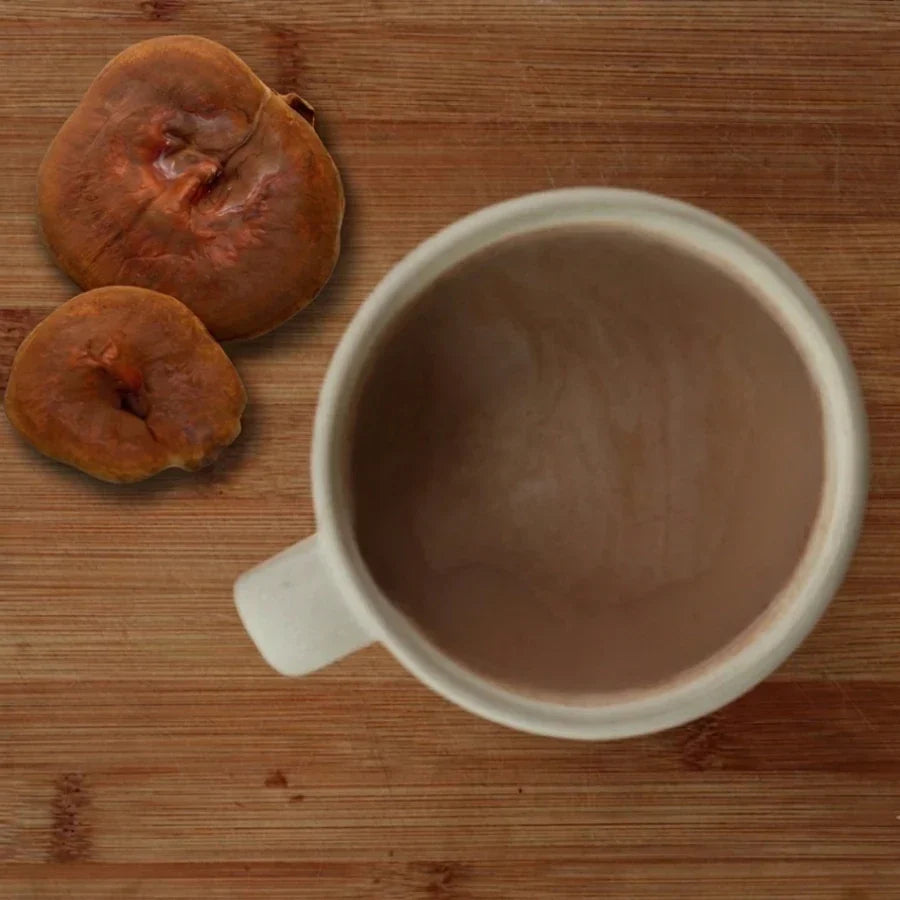
If you have ever looked at a dried Reishi mushroom and wondered how anyone would eat it, the answer is simple: they did not. Reishi is too woody and tough to chew. It was always brewed as a tea or decoction. The hot water extracts water-soluble compounds, particularly beta-glucans and certain triterpenes, thereby making them available for absorption.
This guide covers three ways to make Reishi tea, what the research says about the compounds you are actually extracting, and what to look for if you want to get the most from your brew.
Three Ways to Make Reishi Mushroom Tea
Not all Reishi tea is made the same way, and the method you choose affects what compounds end up in your cup.
Method 1: Traditional Decoction (Dried Reishi Slices)
This is the oldest method, and it is still widely practised across China, Japan, and Korea.
- Take 3 to 5 grams of dried Reishi slices (about 2 to 3 thin slices)
- Place them in a pot with 500ml to 750ml of water
- Bring to a gentle boil, then reduce to a low simmer
- Simmer for 1 to 2 hours, allowing the liquid to reduce by about half
- Strain and drink warm
The resulting tea is dark amber to brown, with a distinctly bitter, earthy taste. The bitterness comes from triterpenes, particularly ganoderic acids. If your Reishi tea is not bitter, the slices may not be genuine Ganoderma lucidum or may be of very low quality.
What you extract: Primarily beta-glucans and water-soluble polysaccharides. Some triterpenes will dissolve during the long simmer, but many ganoderic acids are not fully water-soluble. This is the key limitation of traditional Reishi tea compared to a dual-extracted product.
You can reuse the slices for a second brew, though the second batch will be weaker. Some people simmer the same slices twice and combine both batches.
Method 2: Reishi Extract Powder Tea (Quick Method)
If you are using a pre-extracted Reishi powder (one that has already undergone hot water and/or ethanol extraction), the process is much simpler:
- Add 500mg to 1,000mg of Reishi extract powder to a mug
- Pour hot water (not boiling, around 80°C is fine)
- Stir until dissolved
- Drink as-is or add flavourings
Because the extract has already been processed, you do not need to simmer for hours. The bioactive compounds have already been freed from the chitin cell walls during extraction. You are simply dissolving the finished extract in water.
What you get: If the extract is dual-extracted (hot water + ethanol), you get both beta-glucans and triterpenes in a single cup. This is actually more complete than traditional tea, despite being faster to prepare.
Method 3: Reishi Chai / Flavoured Blends
Reishi's bitter, earthy flavour pairs naturally with warming spices. A simple Reishi chai:
- Simmer 500mg to 1,000mg of Reishi extract powder in 200 mL of water for 2 to 3 minutes
- Add a cinnamon stick, 2 to 3 slices of fresh ginger, and 2 to 3 whole cloves
- Add 100ml of your preferred milk (oat, coconut, or dairy)
- Sweeten with honey or maple syrup to taste
- Strain and serve
The spices complement the bitterness rather than masking it. Cinnamon and ginger in particular create a warming, grounding drink that many people enjoy as an evening ritual.
What Does Reishi Tea Actually Contain?
The compounds in your cup depend entirely on your preparation method. Here is what the science says about extraction:
Water-Soluble Compounds (What Tea Extracts)
- Beta-glucans: The primary polysaccharides in Reishi cell walls. Hot water extraction is the standard method for releasing them. Research has identified beta-glucans as the most abundant bioactive polysaccharides in Ganoderma lucidum (Boh et al., 2007).
- Some triterpenes: A small percentage of ganoderic acids are partially water-soluble and will dissolve during a long simmer. However, the majority require ethanol for full extraction.
- Polysaccharide-protein complexes: Reishi contains glycoproteins and proteoglycans that dissolve in hot water.
What Tea Does Not Extract Well
- Most triterpenes and ganoderic acids: These compounds are largely ethanol-soluble. Traditional Reishi tea captures some, but not the full triterpene profile. A 2012 study found that ethanol extraction yielded significantly higher triterpene content than water extraction alone (Hsu et al., 2012).
- Sterols: Compounds such as ergosterol require ethanol or other nonpolar solvents.
This is why dual-extracted Reishi products exist. Traditional tea provides beta-glucans effectively, but if you want the full compound profile, including the ganoderic acids that give Reishi its characteristic bitterness, a dual-extracted powder dissolved in hot water offers a more complete profile than a traditional brew.
We make this extract. Organic Reishi, dual-extracted, ganoderic acids verified.
Shop Reishi →Does Reishi Tea Have Caffeine?
No. Reishi is a mushroom, not a plant from the Camellia sinensis family. It contains zero caffeine. This is one reason Reishi tea is often consumed in the evening. It will not interfere with sleep the way caffeinated tea or coffee would.
If you are looking for a warm evening drink to replace caffeinated tea, Reishi tea is a straightforward swap. The flavour profile is very different (bitter and earthy rather than tannic), but the ritual is the same.
What Does Reishi Tea Taste Like?
Bitter. There is no polite way to describe it. Quality Reishi is bitter because it contains triterpenes, and the bitterness is a direct indicator of triterpene content. Traditional Chinese medicine actually values the bitterness as a sign of quality.
If you find the taste challenging, there are a few ways to work with it rather than against it:
- Cinnamon and ginger complement the bitterness with warmth and spice
- Honey or maple syrup takes the edge off without eliminating it
- Cacao or raw chocolate pairs surprisingly well, as both share bitter, earthy flavour profiles
- Milk or milk alternatives soften the mouthfeel and reduce perceived bitterness
If a Reishi product has no bitterness at all, that is worth questioning. It may indicate low triterpene content, which could mean poor extraction, short growing time, or a product made from mycelium rather than the fruiting body.
How Much Reishi Tea Should You Drink?
General guidance based on traditional use and supplement standards:
| Form | Amount per Cup | Frequency |
|---|---|---|
| Dried slices (traditional) | 3 to 5 grams simmered in 500-750ml water | 1 cup daily |
| Extract powder | 500mg to 1,000mg | 1 to 2 cups daily |
| Reishi chai blend | 500mg to 1,000mg extract + spices | 1 cup daily (evening) |
There is no established clinical dose for Reishi from large-scale human trials. These amounts are based on traditional use and current supplement industry standards. Start at the lower end if you are new to Reishi.
Consistency matters more than quantity. Daily use over weeks is more meaningful than a single large dose.
How to Choose Reishi for Tea
Whether you are buying dried slices or extract powder, the same quality principles apply:
- Fruiting body, not mycelium-on-grain. Reishi tea should be made from the actual mushroom (Ganoderma lucidum fruiting body), not ground-up grain with mycelium running through it. Mycelium-on-grain products contain a significant amount of starch and far fewer triterpenes.
- Log-grown (Duanwood) if buying slices. Reishi grown on hardwood logs for 9 to 12 months produces denser fruiting bodies with higher triterpene content than bag-grown alternatives.
- Dual-extracted if buying powder. A powder that has undergone both hot water and ethanol extraction will yield a more complete compound profile than hot water alone, even when dissolved in tea.
- Third-party tested. Look for products that publish Certificates of Analysis from an independent, ISO 17025-accredited laboratory showing verified beta-glucan and triterpene content.
Try Reishi Extract Powder in Your Tea
Mycogenius Reishi is grown for over 11 months on hardwood logs using the traditional Duanwood method. Dual-extracted with verified ganoderic acid and triterpene content. Dissolves in hot water in seconds, giving you a more complete brew than traditional simmering alone. Every batch is third-party tested at an ISO 17025-accredited laboratory.
Ready to try Lion's Mane?
Organic 1:1 extract. Over 40% beta-glucans. Third-party tested.
Shop Lion's ManeFrequently Asked Questions
What are the benefits of Reishi mushroom tea?
Reishi mushroom tea has been consumed for over 2,000 years in traditional East Asian medicine. Hot water brewing extracts beta-glucans and polysaccharide-protein complexes from the mushroom. Research has identified over 400 bioactive compounds in Ganoderma lucidum, though most studies are preclinical. The compounds most studied are beta-glucans and ganoderic acids (triterpenes). Traditional tea captures beta-glucans well but extracts fewer triterpenes than a dual-extracted product.
How do you make Reishi mushroom tea?
There are two main methods. Traditional: simmer 3 to 5 grams of dried Reishi slices in 500-750ml water for 1 to 2 hours, then strain and drink. Quick method: dissolve 500mg to 1,000mg of pre-extracted Reishi powder in a cup of hot water. The extract method is faster and, if the extract is dual-extracted, provides a more complete compound profile than traditional simmering.
Does Reishi tea have caffeine?
No. Reishi is a mushroom, not a tea plant. It contains zero caffeine. This makes it a suitable warm evening drink without interfering with sleep. Many people drink Reishi tea in the evening as part of their wind-down routine.
What does Reishi tea taste like?
Bitter and earthy. The bitterness comes from triterpenes, particularly ganoderic acids, and is considered a positive indicator of quality. If a Reishi product is not bitter, it may be low in triterpenes. The bitterness can be balanced with cinnamon, ginger, honey, or cacao.
Can you drink Reishi tea every day?
Traditional use of Reishi tea involves daily consumption over extended periods. There is no established evidence of harm from daily use at standard amounts (3-5g dried slices or 500-1,000mg extract). As with any supplement, consult a healthcare professional if you are pregnant, nursing, take medications, or have a medical condition. People on blood-thinning medication should seek medical advice before consuming Reishi regularly.
Is Reishi mushroom tea better than capsules?
There are different delivery methods for the same compounds. If both use the same quality extract (dual-extracted, fruiting body), the bioactive content is equivalent. Tea offers the ritual of a warm drink and lets you taste the bitterness (a quality indicator). Capsules are more convenient and have no taste. Neither is inherently better.
Get the Dosage & Timing Cheat Sheet
Exact amounts and best timing for all six species, on one page. Free PDF, straight to your screen.
Something went wrong; please try again.
You'll also get our occasional research-based newsletter. Unsubscribe any time.
Done. Here's your cheat sheet.
We've also emailed you a copy so you can find it later.
Download the PDFMycogenius Reishi Extract
Organic dual extract. Ganoderic acids ≥1.5%. Grown 9+ months on hardwood logs. Third-party tested.
★★★★★ 4.7 on Trustpilot
Shop Reishi